Thursday, 2 July 2015

enigmatic puzzle - Falcon Circus, Chapter 3: The Jungle


You get up and dust yourself off. Pushing extra leaves and vines out of the way, the sign reads, "THIS WAY! THAT WAY! NO WAY? YES WAY!" You let out a big sigh. Oh boy. There was one door in the beginning that seemed to have multiple voices contradicting each other... you look at the flyer for a hint as to what the creatures look like.


$\hskip2.5in$updated flyer


Huh. That's strange. You could have sworn the flyer looked different before... whatever. You point out each member. "Twins... Snake... Lalia... ah-ha! These little gremlin-looking things must be the creatures I'm looking for." With a target acquired, you set out on your journey.


$\hskip0.3in$beginning room $\hskip1.4in$leftforwardbackright


Hint 1:


Indeed, you have oriented yourself in this great expanse. Three dead ends and three creatures to rule the jungle. Each has left a message for you. Quite unfulfilling riddles, no? I suppose children aren't very good at riddles; they also aren't good at numbers or directions. Perhaps they need some guidance in their life.


Wednesday, 1 July 2015

pattern - What is a Cyclone Phrase™?


If a phrase adheres to a certain rule, then I call it a Cyclone Phrase™.


Use the examples below to find the rule. Also find the one error in the chart below. (In other words, one of the phrases below is not really a Cyclone Phrase™.)


enter image description here


If you liked this puzzle, try its successors:
What is a Scalable Phrase™?
What is a Triad Phrase™?


Answer


Each word in a cyclone phrase has


its letters in alphabetical order if you alternate taking them from the left and right sides. For example: dehorned --> ddeehnor, and adjourned --> addejnoru.


A cyclone phrase is made of cyclone words only. A word is called a cyclone word because it is in alphabetical order if you go around it like this:


enter image description here


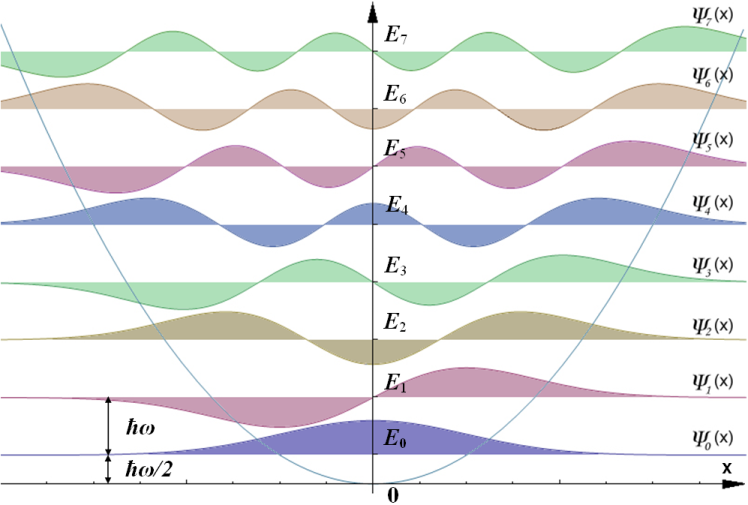
hilbert space - Conceptual understanding of the Quantum Harmonic oscillator


First: When we consider a quantum particle in a harmonic (quadratic) potential we say that this particle is a harmonic oscillator, because it behaves like one. Is this correct?


Now let us assume our particle is in the groundstate $\mid \psi_0 \rangle$. This would mean that in this picture it would be described by the lowest wave with energy $E_0$.


I have a bit of a hard time to understand what happens when we increase the energy of said particle. The old wave function disappears and we find our particle in a new state $\mid \psi_n\rangle$ with some new energy $E_n$ described by a new wave in the picture. Is that correct?


Honestly, I'm giving a presentation on this topic soon, and want to visualize such a 'jump' from a lower energy state to a higher energy state of a particle in the harmonic potential, in the correct way.


Any help is greatly appreciated!


homework and exercises - Total angular momentum of earth


I have problem understanding total angular momentum of earth about center of sun. Consider that earth has an orbital angular velocity of $\omega_0 \hat z$ and a spin angular velocity of $\omega_s \hat s$, distance between the centers of sun and earth as $R$ and radius of earth as $r$ and that earth has mass $m$. My understanding is that total angular momentum of center of mass of earth + angular momentum about CM of earth is $$L = m R^2 \omega_0 \hat z + \frac{2}{5} m r^2 \omega_s \hat s $$ however a it's given in my text book as $$L = m R^2 \omega_0 \hat z + \frac{2}{5} m r^2(\omega_s \hat s + \omega_0 \hat z) $$


Why does the the $\omega_0$ appear when calculating angular momentum about CM of earth?


Answer


You have to be a little careful what you mean by "spin" in a system like the one you're talking about. Ideally, we'd measure everything in an inertial reference frame (one that is fixed with respect to the "fixed" stars at infinity), but often that is not actually how we talk about things in an everyday sense. When you talk about the spin of the earth, for example, would you say that it rotates once every twenty-four hours? Because, actually, 24 hours is the time it takes for the earth to rotate once with respect to the direction of the sun (or, viewed from earth's surface, the interval of time between when the sun is directly north or south in the sky, and the next time it is directly north or south). But because of the earth's revolution around the sun, the direction to the sun changes with respect to the fixed stars changes over time. So, 24 hours (the length of a so-called stellar day) is NOT the rotation period of the earth with respect to an inertial frame. The latter happens to be shorter by about four minutes (24 hours / 365) and is called the sidereal day.


All this may seem a little unrelated to your question, but bear with me. If we want to separately consider the spin angular momentum and orbital angular momentum in a system such as yours, the mathematics (which I won't derive in detail here) allows us to do so if either:


1) The spinning orbiter is so small that it can be considered a point-mass compared to the overall system (note in your case, that the book's first term swamps the $2/5 m r^2 w_o$ term regardless of the relative sizes of $w_o$ and $w_s$).


or


2) For the orbital part, we consider the system rotating as a whole as a rigid body. This means, in particular, that for the orbital part, we must assume that the SAME side of the earth faces the sun at all times. If instead, we let the earth remain facing the same direction with respect to the fixed stars, the corresponding earth-sun system would not be rigid. (To picture all this, it may help to imagine drawing the sun as a circle at the center of an old-style audio record. Then, draw the earth as a circle at the edge of the record and shade the side that points towards the "sun". Clearly, as the record rotates rigidly, the shaded side of the earth points in all directions around the room. If we tried to keep it facing, say, North, at all times while the record rotated, then the record could not be rigid.)


So here then is the overall answer to your question. We want to break the total angular momentum of the earth into an orbital piece and a spin piece. Due to the discussion above, the orbital piece must include a contribution from the fact that the earth would rotate once every 365 days if it was rigidly attached to the sun. The last term that the book adds is exactly this piece... even though it is grouped with the spin contribution, the appearance of $w_o$ shows that it is actually "orbital" in origin. The book is then considering $w_s$ to be the spin of the earth relative to the sun (that is relative to if the earth actually was rigidly tied to the sun), rather than to the fixed stars. Your formula is correct if $w_s$ was instead the spin relative to the fixed stars (which would be harder to measure from here on earth, but would not be invalid if done that way). It comes back to the difference between a stellar and a sidereal day, and how one wants to break things up. Both can be correct, but one must be careful to define one's terms and use symbols consistently.


Hope that helps.


newtonian mechanics - Conservation of momentum when rain pours into a wagon


Suppose a wagon is moving at constant velocity on a friction-less surface, and rain begins to fill the wagon.


The net force on the wagon is zero, so momentum is conserved; as the mass of the wagon increases, the speed decreases. But if the velocity of the wagon changes, the net force can't be zero, right?


There has to be some force opposing the motion of the wagon to slow it down. How do we reconcile this?


Answer


To deal with this type of problem, you must be careful to define exactly what system you are dealing with, and then not change that system part way through the problem. This definition allows you to be very clear about whether the "system" has any external forces acting, and thus whether the momentum of the system is constant or not.


In this case, you seem to be defining the wagon itself as the system, but then talk about the wagon as gaining weight, implying that the definition of what constitutes the wagon system is changing.


Let's try this: the system is the wagon itself, without any stray mass that may be added. The wagon has a certain amount of momentum, and since there is no outside force of friction, that momentum is constant.


But then the rain starts to fall. None of this rain is included in the system, even though it gets trapped inside the wagon. But in being trapped, the vertically falling rain also exerts an horizontal force on the system: either impacting the back of the wagon in the air, or hitting the bottom, and flowing towards the back of the wagon. All this means that there is an external force exerted by the rain on the system, and momentum of the system is not conserved.


We can start over: the system now is defined as including the wagon and all the vertically falling water. Since the rain initially has no horizontal velocity, the total momentum of this new system is just that of the wagon.


Now the rain starts hitting the wagon. But under our new definition, all of the rain impacting is an internal force, and cannot change the total momentum. This new system is isolated and momentum is conserved. So now, since more and more of the system is travelling with the wagon, the wagon must slow down. Internally, momentum is being transferred from the wagon part to the rain part of the overall system.


visual - Lights in the Dungeon: Three by Three


This is the first in a series Lights in the Dungeon puzzles.


It is intended to be easy to help work out unpredicted kinks for future puzzles that are built around the same story.


-> next (2nd)


You have been captured by Lord Hooty McOwlface, a cruel tyrant that tightly controls his territory with an iron talon fist. The dungeon is cold and without comforts but you are only kept there for a single night before you are hauled before the demonic ruler.


"You are a very lucky human!" screeches the despot. "We are going to play some games. If you perform poorly, you shall be eaten! But, if you perform well, you shall get to play another game! Does that sound fair?"


"Well," you stammer as you try to look at anything except his terrible countenance, "I suppose that's better than being eaten right away, isn't it?"


"Of course it is! My grand vizier shall inform you of the rules. Be careful not to damage your delicious flesh if you lose. I would be most displeased." A bright purple cat disengages itself from the Lord's grasp and leaps from the arm of the throne. It approaches you with a scroll held in it's teeth.


"Is this your grand vizier?" you ask, incredulity sneaking into your voice.


"Fakky Jim is a trusted and noble creature! He is far superior to humans. Also, he's magic. Why did you think he was purple?"


You accept the scroll and unroll it to reveal the following rules:


  1. You will be placed in a dungeon in which there are many rooms. Each room has a single light in the middle. You must turn off every light.

  2. The lights are easily turned off by a short chain hanging from the fixture.

  3. As soon as you exit a room, the floor will collapse to reveal the thousand-foot chasm below. You may not re-enter a room and, therefore, must turn off each light by passing through each room exactly once.

  4. The map below shows the current design of the dungeon with each room bordered by red and labeled with a alphabetic character.

  5. You may rearrange the rooms however you like before you enter but you cannot change the overall dimensions of the dungeon. In this case, that means the dungeon must be three rooms wide and three rooms tall.

  6. You cannot rotate or flip rooms. You may only translate them.

  7. You may only enter the dungeon once and exit once. As soon as you exit the dungeon, any remaining floors will collapse.

  8. If there are any rooms not visited and, therefore, any lights left on, you lose. If all lights are turned off when you exit the dungeon, then you win.


How can you rearrange the dungeon rooms so that you can win the game?


There are probably multiple solutions. The first valid answer will be accepted.


Maze 3x3


For reference, here are the 16 possible rooms. (Note that this is all possible rooms. For this puzzle, you must use exactly the rooms shown in the map above.)


ABCDEFGHIJKLMNOP


Answer


I hope I got this right:


Solution


Looking forward to the next one!


electrostatics - What does grounding a plate mean happens to the charge?


In the context of image charges. Let say I have a very large grounded/earthed plate. If initially the total charge on the plate is 0 then we place a positive point charge, $Q$ just above its surface (at its centre). If the plate was not grounded/earthed then I know we would get a surface charge of $-Q$ on the top plane of the plate with the positive charge $Q$ distributed on the lower side of the plate so that the net charge on the plate remains $0$. But in the case of the grounded plate can we still say that the net charge on the plate is $0$? Or are charges allowed to move to and from ground?


My attempt at an answer: I don't think this is the case since grounding only defines the potential of the plate to be $0$. There is no closed circuit for electrons to flow to or from ground and therefore the net charge of the plate remains $0$.


Answer


I don't think this is the case since grounding only defines the potential of the plate to be 0.


There's more. An ideal ground can supply / absorb an arbitrary amount of charge while remaining at zero potential.


"A grounded conductor is a special type of equipotential: infinite amounts of electrical charge (± Q) can flow from / to ground to / from the conducting surface so as to maintain electrostatic potential V = 0 (Volts) at all times."


If your conducting plane is connected to an ideal ground, the plane can have zero potential and have net electric charge.


There is no closed circuit for electrons to flow to or from ground and therefore the net charge of the plate remains 0.


One doesn't need a closed path for electrons to flow except in the context of electric circuits. Electrons flow back and forth along, e.g., a long wire antenna and there is no closed path.


enter image description here


At any rate, for the problem of a large (effectively infinite) grounded conducting plane, if there is a charge $Q$ above the plane, there is net electric charge $-Q$ induced on the plane. See, for example, section 3.2.2 of Griffiths "Introduction to Electrodynamics", 4th edition.


Understanding Stagnation point in pitot fluid

What is stagnation point in fluid mechanics. At the open end of the pitot tube the velocity of the fluid becomes zero.But that should result...