Sunday, 27 September 2015

pattern - Hard questions from an IQ test


I have edited the post to reduce the number of questions (I only kept the ones that were already answered) and I am creating a new post


The questions are from the test taken from the website: http://www.iq-brain.com/example/1


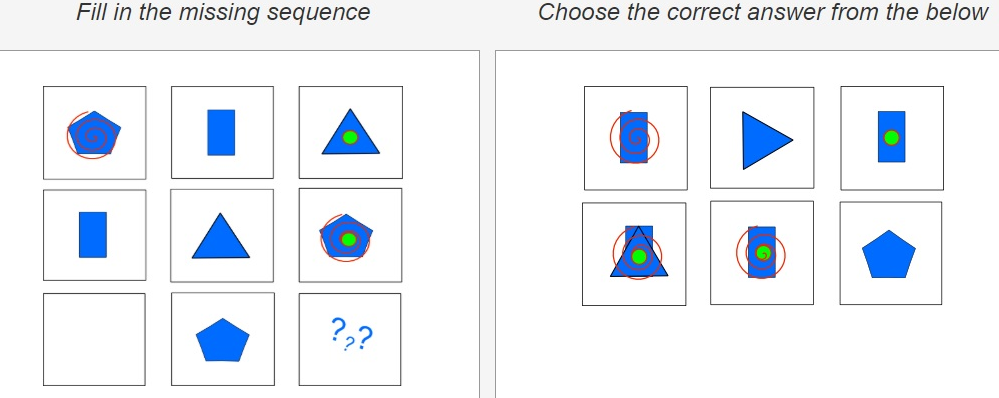
1: enter image description here


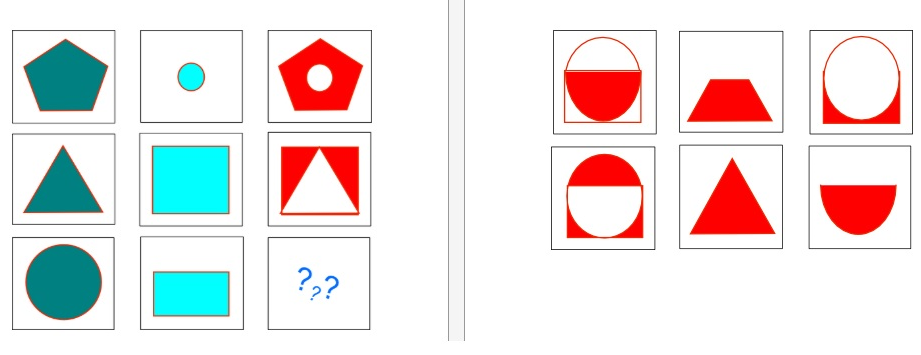
2: enter image description here


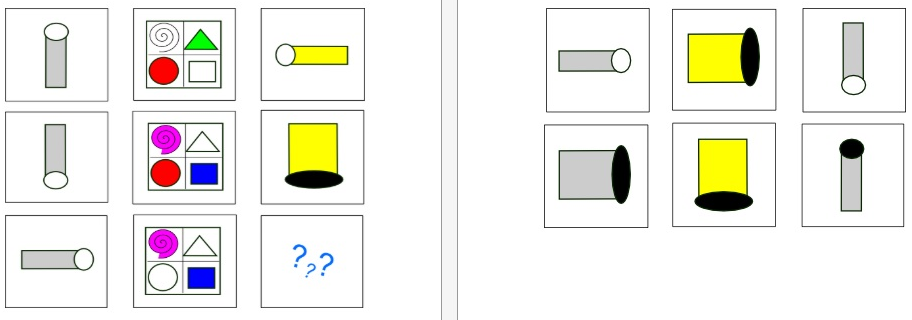
5: enter image description here


Answer


2.


Bottom left. When the first two shapes are superimposed, regions that are only occupied by one shape are red, by both are white.


5.


Bottom left. Purple\Blue is widen, turn tip black. Green is rotate, Red is turn body yellow.


special relativity - Relevance of spinor in relativistic (classical) electrodynamics


I'm following a course about relativity and electrodynamics (not the "quantum" one), and the lecture notes introduces the concept of spinor by a map between an orthogonal basis in Minkowski spacetime and the pauli matrices with the identical matrix as the temporal part, like


$$ T: M^4 \rightarrow H(2,C) $$ $$ T(e_0) = I,\,\,\,\, T(e_i) = \sigma_i, i = 1,2,3 $$


It introduces some formulas like the direct mapping and its inverse as $$ v_i = \frac{1}{2}Tr(\hat{v}\sigma_i) $$ and the norm as the determinant of the resulting hermitian matrix. It explain that SL(2,C) is a double covering of the Lorentz group. And that's all. I mean, the notes don't speak about the spinor ever again.


So I wonder, why are they introduced in a course about classical relativistic electrodynamics? can some phenomena being explained using spinors that can't be explained using old good 4-vectors? or should I take it as a mathematical curiosity until I get introduced to quantum electrodynamics and dirac spinor (which I know is the direct sum of a Weyl left and right spinor)?


Answer


Transformations of the Faraday tensor by the spinor map and Lorentz transformation calculations are often less messy than their $S0(1,\,3)$ counterparts.


Even the most everyday and mundane EM calculations (without needing to do Lorentz transformations) can benefit from this: I have in my time written many lines of code to simulate electromagnetic propagation, and I use the following representation almost exclusively in my codes: code becomes VASTLY less complicated and much more readable - an more importantly maintainable - in this notation (you do need to be writing in an OO language (to allow tensor, quaternion, matrix etc classes) with operator overloading implemented for these comments to hold true. C++, Ada and I believe Python and the modernest version of Fortran also qualify (I only have direct experience of the former two)). There is also a modest code speedup for some spinor operations, but that's becoming less important these days.


We can write the Faraday tensor in the space of $2\times2$ Hermitian matrices as follows:


$$\begin{array}{lcl}F_\pm &=& \left(\begin{array}{cc}E_z & E_x - i E_y\\E_x + i E_y & -E_z\end{array}\right) \pm i \,c\,\left(\begin{array}{cc}B_z & B_x - i B_y\\B_x + i B_y & -B_z\end{array}\right)\\ & =& E_x \sigma_1 + E_y \sigma_2+E_z\sigma_3 + i\,c\,\left(B_x \sigma_1 + B_y \sigma_2+B_z\sigma_3\right)\end{array}\tag 1$$


where one often keeps both the $+$ and $-$ form but one throws away the negative frequency part. In this notation, $F_+$ is the left hand circularly polarized part of the field and $F_-$ the right.


The Pauli spin matrices are simply Hamilton's imaginary quaternion units reordered and where $i=\sigma_1\,\sigma_2\,\sigma_3$ so that $i^2 = -1$. When inertial reference frames are shifted by a proper Lorentz transformation:


$$\Lambda = \exp\left(\frac{1}{2}W\right)\tag 2$$


where:


$$W = \left(\eta^1 + i\theta \chi^1\right) \sigma_1 + \left(\eta^2 + i\theta \chi^2\right) \sigma_2 + \left(\eta^3 + i\theta \chi^3\right) \sigma_3\tag3$$


encodes the transformation's rotation angle $\theta$, the direction cosines of $\chi^j$ of its rotation axes and its rapidities $\eta^j$, the entities $F_\pm$ undergo the spinor map:


$$F_\pm \mapsto \Lambda \,F_\pm \Lambda^\dagger\tag 4$$


We can write Maxwell's equations in their quaternion form:


$$\begin{array}{lcl} \left(c^{-1}\partial_t + \sigma_1 \partial_x + \sigma_2 \partial_y + \sigma_3 \partial_z\right) \,F_+ &=& 0\\ \left(c^{-1}\partial_t - \sigma_1 \partial_x - \sigma_2 \partial_y - \sigma_3 \partial_z\right) \,F_- &=& 0\end{array}\tag 5$$


which are actually the Dirac equation (when Weyl spinors instead of Dirac ones are used) for a massless particle.


See my answer here for some more information on the physical meanings of the above.


Question from OP


...I would want to know what is the relation (mapping?) between the Faraday tensor in Minkowski and this one..


They are identical, in the senses that:


  1. If you solve (5) with appropriate boundary conditions and other forms of Maxwell's equations with the same boundary conditions, then the field components you read off (1) as functions of time and space will be exactly the same answers that you get from any other method of solution;


  2. If you transform between relatively boosted and rotated frames using (4), you'll get exactly the same answer that you get by acting on the left and right of the wonted form of the Faraday tensor with the relevant Lorentz transformation written in the matrix representation of $SO(1,\,3)$. Witness that the form of (4) looks exactly like the transformation of the rank 2 tensor (insofar that you need two Lorentz matrices for that one too).


The "differences" are:


  1. The difference between contravariant and covariant forms of $F$ are hard to spot and subtle in this notation. Multiplying the rank two Faraday tensor by the Minkowski metric $\eta$, i.e. raising or lowering indices is, by (1), taking the negative Hermitian conjugate of the $F_\pm$ quantities.


  2. Two boosts, both $+\Lambda\in SL(2,\,\mathbb{C})$ and $-\Lambda\in SL(2,\,\mathbb{C})$ in the form (2) have the same action as a single boost in $SO(1,\,2)$ because $SL(2,\,\mathbb{C})$ is the simply connected double cover of $SO(1,\,3)$ - the two groups are identical in the small, but have different global topology.


gravity - Does light have mass?


  1. Does light have mass?


  2. If yes, will it exert force?


  3. If no, then how are light particles are travelling at light speed?


  4. If light doesn't have mass how is it attracted by gravitational force (black holes)?


  5. And what actually is light?


Answer


Photons having zero rest mass is precisely the reason why they travel at light speed. A particle can have momentum without having mass, the only condition is $$(mc^2)^2=E^2-(pc)^2$$ in the case of light, left side is zero and $E=pc$ where $E$ is energy and $p$ is linear momentum.


Furthermore, the gravitational attraction isn't really attraction in the traditional sense. Gravitation curves the space-time so that the geodesic (the locally straightest and shortest path, which the light takes) is curved. So the light just goes along its way, as straight as it can get, and the curvature of the space makes this geodesic path deflect in angle when the ray passes a massive object.


Light is an electromagnetic wave - change in electric field induces magnetic field, and change in magnetic field induces electric field again... this cycle propagates in space with the speed of light.


Saturday, 26 September 2015

newtonian mechanics - Coriolis force and Newton's third law


I would like to ask a stupid question here.


If a body 'b' moving downward with a velocity $v$ in a rotating frame of reference with angular velocity $\omega$, and $\omega$ and $v$ not being parallel and anti parallel. We all know that the body 'b' experiences a Coriolis force.


If it gets deflected in its trajectory then according to newtons third law shouldn't it push some body with equal force?


what if the frame of reference was moon where there is no atmosphere? will the body be deflected?


Answer


Nothing feels a reaction force to the Coriolis force because Newton's laws only apply in an inertial frame. If we imagine a frame with some sort of wild, random acceleration, then in that frame at a given moment it would look like, in a room with completely stationary tables and chairs and things, everything was simultaneously accelerating the same direction, and there would be huge "fictitious forces" needed to explain this. There are no third-law pairs going on, though. The fictitious forces were necessary to make $F=ma$ work out in this accelerating frame, but by introducing them we sacrificed the third law (at least in regards to those kinematic forces).


Imagine dropping a ball off a tower. It gets deflected east.


If we analyze this scenario from a frame rotating along with the Earth, there is no conflict with Newton's third law because it does not hold for the Coriolis force or other kinematic forces.


If we analyze the scenario from an inertial frame in which the Earth is rotating, the trajectory simply is not deflected. The ball lands east of where it was dropped because its velocity in a tangential direction, which comes from the rotation of the Earth, stayed the same, but as it fell its angular velocity $v/r$ increased because $r$ decreased. That led it to "deflect east" when it was really moving in a perfectly ordinary parabola.


nuclear physics - The "binding energy" of bonded particles adds mass?


This is a follow-up my previous question. Several of the answers indicated that the mass of a particle (atom, proton, etc.) increase with the "binding energy" of it's component particles - the energy needed to split them apart - which doesn't make sense to me. I'm convinced that, at least in an exothermic chemical reaction (where the product bond energies are larger) the product's particles will lose mass (proportionally to the heat dissipated) or at least have no change.


To use a larger-scale analogy, if an object, a "particle", is 100m above the Earth's surface, it has potential energy from gravity. As it falls, this energy is lost, converted into KE. Overall, the two "particles", the object and the Earth, end up with the total energy, and therefore the same total mass. There is no room for a "binding energy" that adds mass.


My reasoning is that this extends to particles, with electrostatic or nuclear forces taking the place of gravity. Potential energy of component particles becomes KE of the bonded particle, they end up with the same mass. Actually, if this KE is dissipated (as in a burning / nuclear fusion reaction) the particles should actually have more mass in their uncombined/unreacted state, thanks to their PE. Surely it isn't possible for the mass to increase without an external input of energy?


However, answerers of my energy in chemical reactions question said that:


the energy involved in the bonds is ... half of what we normally consider the "mass" of the proton - David Zaslavsky


and


potential energy of the chemical bonds do correspond to an increase of mass - Ben Hocking


So, how can this be, and where is my reasoning incorrect? What exactly is the binding energy (if not just the energy needed to break the bond), and where does it come from?


Friday, 25 September 2015

particle physics - Why are high energies equivalent to short distances?


Why are the regimes in high-energy collisions called short distances?


Qualitatively I only know that the higher the given energy of the colliding particles "the smaller are the pieces yielded by cracking the collision particles". Is there a quantitative derivation of the term relating the energy $E$ and the distance $x$?


Answer


Energy is related to frequency via Planck's relationship $E=h\nu$ and frequency is related to wavelength via the speed of light $\nu=c/\lambda$. Therefore, the higher the energy the smaller the associated wavelength. This wavelength represents the resolution with which one makes an observation.


hilbert space - Is non-linear quantum mechanics possible?


Say we have a state vector $|A\rangle$. Is it possible to have a theory where the evolution of $|A\rangle$ depends on the vector $|A\rangle$ itself? e.g.


$$ i\frac{\partial}{\partial t} \psi(t) = \hat{F}(\psi(t)) \psi(t) $$


On reason I was thinking about this was the idea that space-time is related to entanglement. But entanglement means knowledge of the state-vector. So if this were true, the state-vector would have to affect itself.


In other words is non-linear quantum mechanics possible?


Understanding Stagnation point in pitot fluid

What is stagnation point in fluid mechanics. At the open end of the pitot tube the velocity of the fluid becomes zero.But that should result...