Saturday, 3 October 2015

riddle - A Pi day What Am I?


Another Pi day themed puzzle like my other one.


I contain 5 letters,


I only have 1 syllable,


I can be referred to as money,


Or I can be the foundation of something wonderful (and quite popular too),


I can come before a word similar to “crazy” to be something sweet,


I have silent letters,


Google describes me as thick and elastic.


What Am I?


Answer


I think you are:


Dough


I think the first three lines are self explanatory.


Can be the foundation of something wonderful


Bread/cookie dough


Can be followed by a word similar to "crazy" to be something sweet


"Nut", to make doughnut/donut


Has silent letters


The gh are silent.


Google describes me as thick and elastic


When you search dough, the little box that pops up describes dough as such.


password - The Security to the Party [XI]


A party is being held at a local mansion. The host is very rich and his success is because of one thing — his famous recipe for spaghetti!


The only guests that may attend are people who correctly reply to the guard at the door.


Here's where you come in. You and a friend are trying to steal this recipe. You sneak by and listen to the passwords.


You notice a chalkboard next to the guard which you haven't seen before. It looks like this:


                    Week XI
---------
This week's passwords were changed 2 days ago since
John the Guard was taken ill, and Carlo the Guard
hasn't had time to learn that system yet.
If you didn't receive the message, please check your
mobile phone for the new rules.

ZERO (0) will never be a correct answer, and none of
the numbers ONE (1), TWO (2) or THREE (3) will be asked

because it's far too insecure, anyone could just repeat
the same number and we don't want that.

You quickly check your mobile phone, just in case they made a horrendous mistake, but you have no messages at all - they're not quite that daft. Any attempts to steal a mobile phone would undoubtedly be noticed by the guards, so you decide it's far too risky to try to game the system, and instead hang around to overhear some challenges and responses.


The first guest arrives. The security says "4", and the guest replies "3".


The second guest arrives. The security says "25", the guest replies "6".


The third guest arrives. The security says "16", the guest replies "5".


Your friend thinks he's got it all figured out - it's just $\sqrt{n}+1$, so he walks up to the door and the security says "49". He replies "8", and is trampled to death by an irrelevant elephant.


Another guest arrives, security says "18" and the guest replies "7" to get in.


You walk up and get a "36" from security. What is your response?


For peace of mind (since someone decided to have a go at me for not stating this upfront on a previous puzzle): Every response is independent of every other challenge/response pair, and there is no hidden information (such as time of day).


This is the latest installment in the series:
The Security to the Party
The Security to the Party [Part 2]
The Security to the Party [Part 3]
The Security to the Party [Part 4]
The Security to the Party [Part 5]

The Security to the Party [Part 6]
The Security to the Party [Part 7]
The Security to the Party [Part 8]
The Security to the Party [Part 9]
The Security to the Party [X]


Answer


My guess is answer maybe


9. Because, the guest reply is equal to number lines in Roman numeral representation for every number said by guard.


Friday, 2 October 2015

quantum mechanics - Multiple Double slit experiment


In school, I am learning about the Double Slit experiment and it's implications on Quantum Mechanics. I was wondering if the double slit experiment was possible with many different slits and screens. For example, if there were 5 sets of slits, light would pass through the first set of slits, and go into a second set of slits, which would be angled at 45˚(or some arbitrary angle) to the first one. If this process is repeated 5 times in total, would there still be some interference effect observed on the final screen.


Answer


A double slit is usually in a first approximation (which you are dealing with in school, probably) just a pair of point sources which are a distance $d$ apart. Sure, each of the slits has technically a width $w$, but unless you are looking at double-slit diffraction and not the simpler$^1$ double-slit interference, you don't care about the size of the individual slits.


Now, the Huygens-Fresnel principle states that in the double-slit experiment, both slits act as point sources emitting spherical waves which will interfere everywhere on the other side on the slit screen. The detection screen is just there to allow for a simple geometric calculation of the pattern along that particular screen.


If you put a second slit screen behind the first one, possibly angled at an angle, no matter what kind of interference pattern might show up along that second slit-screen, the slits will still be pointlike and the secondary (and all subsequent after that) interference pattern will be more or less the same as the first one, barring intensity losses.


So in the first order approximation used in school and introductory optics classes, the interference pattern will not look any different.


Now, of course, if you extend your calculations to account for the diffraction each of the slits composing the double slit, their width $w$ comes into play and since the Huygens-Fresnel principle still says that each point in the slit emits a spherical wave, you will have to take into account the intensity variations the first screen will cause on subsequent ones.


$^1$ Interference and diffraction are more or less the same thing in the sense that both are well explained with the Huygens-Fresnel principle. Usually in school, one deals only with double-slit interference, but you can of course ask what happens to the single-slit properties of each of the slits and how they effect the overall interference picture. That runs under the name of double-slit diffraction, see e.g. in these great MIT notes


experimental physics - What technology can result from such expensive experiment as undertaken in CERN?


I wonder what technology can be obtained from such very expensive experiments/institutes as e.g. undertaken in CERN?


I understand that e.g. the discovery of the Higgs Boson confirms our understanding matter. However, what can result form this effort? Are there examples in history where such experiments directly or indirectly lead to corresponding(!) important new technology? Or is the progress that comes from developing and building such machines greater than those from the actual experimental results?


Answer


The truth is we don't know. But when you think about it, how can we know? If we knew what technology would eventually come out of experiments like this, why would we not build that technology now?


Large expensive machines like the CERN supercollider help us to further understand the laws of nature. And through understanding these laws, new technologies arise. But we, the physicists, have absolutely no idea what wonderful technologies might result tomorrow because we invested so heavily in science today.


It's purported in 1850 after Faraday developed the electric generator, the British minister of finance asked him what practical value there was to electricity. Faraday could not have known that electricity would one day form the backbone of all modern society (but that didn't stop him from making a snarky remark). It's hard to predict the future; we labour in science in the hopes that what we do will prove useful for some new and amazing technologies. But we don't know what technologies will result from our expensive laboratories any more than Faraday knew that electricity would allow you to make a computer.


fluid dynamics - Is Torricelli's law "wrong" for big holes? - Tank draining problem


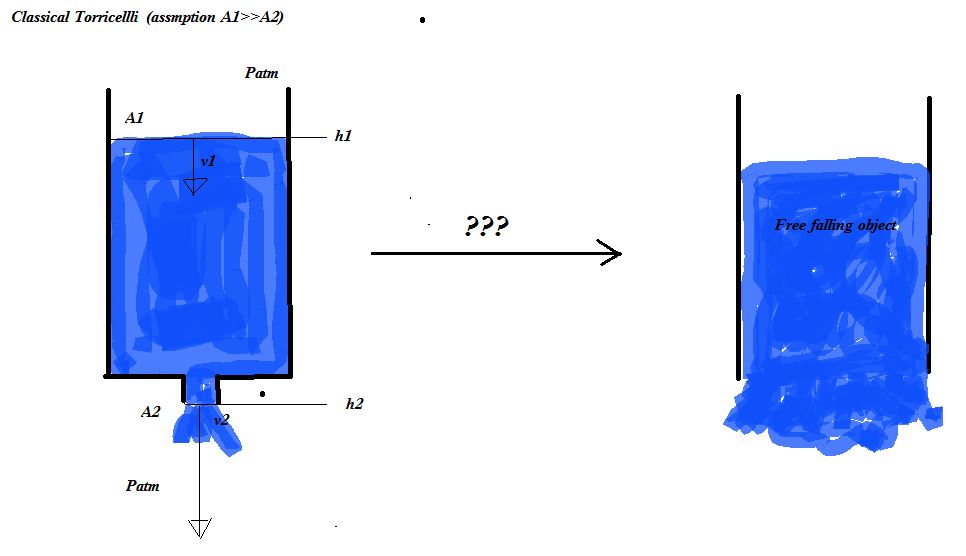
Consider a tank full of water with a constant cross-sectional area A1 placed vertically on the ground. Now someone drills a hole of an area A2 in the bottom of the tank, and the liquid starts escaping through the hole with af velocity v2. At the same time the open surface of the water in the tank will drop with a velocity v1. In order for the mass to be conserved, the following must be true (the water is assumed incompressible):


enter image description here


We are interested in v2. Here is how everybody derives it:


Take bernoulli's equation and assume that the pressure is on the top and the bottom of the cylinder is just atmospheric:


enter image description here


h2 is the high at the bottom of the tank and h1 is the high at the top of the tank, and g is the gravitational acceleration. We just set h2=0, so we are left with:


enter image description here


Everybody who has solved this problem makes the following assumption at this point:


"since A2 << A1, then v1≈0" (which follows from the first equation) This simplifies the equation above to Torricelli's law:enter image description here


But what happens if we don't make that assumption about the hole size and just plug the first equation in? Can this really be true?:


If one removed the bottom of the tank completely, so that A2 approached A1, then the velocity would approach infinity... this is obviously not possible (if one removes the bottom of the tank, then the water should just behave as a free falling object, right?) I have found others, who have derived the same function for v2(h) as that above (eg. first answer in this thread: "Velocity with respect to time in Torricelli's Law"). -And this simulation crashes, if one sets the two areas equal: http://demonstrations.wolfram.com/TorricellisTheorem/.


So the question is: What effect does it have, if we remove the assumption that "A2<< A1" in the derivation of torricelli's law? enter image description here


Answer


I don't think this is as large of a problem as it seems.


Consider the steady state assumption in more detail. $v_2$ is the final velocity going through the hole after sufficient time has passed for the acceleration to occur. Right after you open the hole everything is stationary. There is an acceleration phase which is normally assumed to take a short amount of time.


This assumption is distinct from the $A_1 \gg A_2$ assumption, but the combination of them wreck havoc on the scenarios where the hole is large compared to the water's surface area. After all, $h_1$ is in the expression for $v_2$. That means we have two factors at work 1) initial acceleration of the fluid suppresses the speed early on and 2) depletion of the water level suppresses the speed toward the end of the flow. So to answer your question:


So the question is: What effect does it have, if we remove the assumption that "A2<< A1" in the derivation of torricelli's law?


I think you did it correctly. Infinite flow is predicted due to obviously incorrect assumptions. It simply doesn't have time to accelerate before the water level substantially decreases, and you could use this to derive some very clear bounds of applicability, outside of which, the flow never gets close to the equation's prediction.


condensed matter - Mean field theory = large-$N$ approximation?


Wikipedia entry of $1/N$ expansion (or 't Hooft large-N expansion) mentions that


It (large-$N$) is also extensively used in condensed matter physics where it can be used to provide a rigorous basis for mean field theory.


I would like reference(s) that reviews this connection between MFT and large-$N$.


Answer


I think Adam's answer is excellent, and I'd rather make this a comment but can't as I just signed up in order to answer.


While I agree with most of what Adam said, there are cases where large-N works well for $N=1$. The case I'm familiar with is the large-N expansion for the "Spin Ices" Dy$_2$Ti$_2$O$_7$ and Ho$_2$Ti$_2$O$_7$, which have Ising spins on a pyrochlore lattice. The best reference for this is Sergei Isakov's PhD thesis (University of Stockholm 2004), specifically Section 4.3 and Subsection 4.8.2.


It's noted in that thesis that we shouldn't expect large-N to work for pyrochlores below $N=3$; the expansion is singular at $N=2$ owing to order-by-disorder. Extensive checking against Monte Carlo simulations and experiment verify that the expansion is good for $N=1$ (references given in the thesis), but we don't know why this is.


I found myself needing to prove the equivalence of large-N and MFT at high temperatures. I apologise if it's bad etiquette to reference one's own work, but I provide a mathematical proof in Section 2.4 of my Master's thesis which can be found here (Perimeter Institute 2011).


I believe the main working difference between large-N and MFT is that MFT always contains a non-zero critical temperature $T_c$, but that $T_c\sim 1/N$ with $N$ the number of degrees of freedom at each lattice site. This means that large-N, with $N\rightarrow\infty$, has $T_c=0$ to zeroth order in the $1/N$ expansion (at which one generally works).


forces - Honey, suspending gold flakes


I have a jar of honey that has a load of gold flakes suspended in it. It has been sat still for 24 hours and the flakes have risen to the surface. At least the bigger parts and the small ones stayed as they were. Any ideas as to the physics behind this and also if its possible to prevent the bigger ones from rising to the surface?


Understanding Stagnation point in pitot fluid

What is stagnation point in fluid mechanics. At the open end of the pitot tube the velocity of the fluid becomes zero.But that should result...