The old question How to understand this symmetry in the wavefunctions of a diatomic molecule? explores how it is possible for a quantum state to have zero angular momentum about a given axis (giving it a term $\Sigma$) while using multi-electron effects to stay parity-odd with respect to reflections in planes that contain that axis.
One of the things that fall out of that analysis is that, if this is done using a two-electron system, then the orbital part of the state needs to be odd under exchange, which forces the spin part to be even and therefore forces the spin representation to be a triplet, making the full term symbol ${}^3\Sigma^-$.
My question here is: is it possible to use more than two electrons, coupled in some clever way, to whittle that spin representation down to a singlet, for a full term symbol of ${}^1\Sigma^-$? If so, what is an explicit example? What is the minimal number of electrons needed for such a term? Or are there other restrictions in place that make that term impossible no matter how you try?
From a chemistry perspective (so I am afraid this might not be as rigorous as you guys usually like, but it is what I can offer), we would usually use group theory to determine the term symbol for the molecule. tom has kindly provided the examples of dioxygen and dinitrogen. Since these molecules are centrosymmetric, the term symbol technically should include a gerade/ungerade label as well, i.e. $^1\Sigma_\mathrm g^-$ or $^1\Sigma_\mathrm u^-$, but it's not particularly important.
Using dioxygen as an example ($D_{\infty\mathrm h}$ point group, character table here) and ignoring the core 1s-electrons, the ground state has the electronic configuration $(1\sigma_\mathrm g)^2(1\sigma_\mathrm u)^2(2\sigma_\mathrm g)^2(1\pi_\mathrm u)^4(1\pi_\mathrm g)^2$. A quick sketch of the MO diagram is provided below.
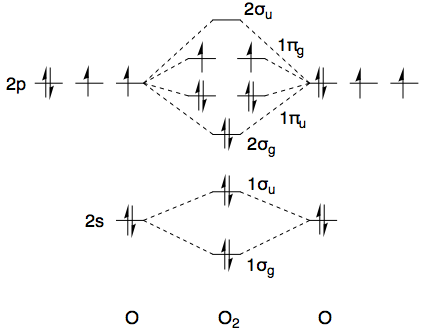
The first ten electrons are all paired up and collectively transform as the totally symmetric irreducible representation, i.e. $\Sigma_\mathrm g^+$, so from a symmetry point of view we only need to consider the top two electrons. Both electrons are in a $\pi_\mathrm g$ orbital, and collectively these transform as the direct product of $\Pi_\mathrm g$ with itself. (Irreducible representations are labelled with capital Greek letters, whereas small letters are used for MO symmetry labels.)
$$\Pi_\mathrm g \times \Pi_\mathrm g = \Sigma_\mathrm g^+ + [\Sigma_\mathrm g^-] + \Delta_\mathrm g$$
This means that a $(\pi_\mathrm g)^2$ configuration can have an overall symmetry of either of these three, depending on how the electrons are configured. Now, the square brackets come into play: these represent antisymmetrised direct products, i.e. spatial wavefunctions which are antisymmetric upon permutation of the two $\pi_\mathrm g$ electrons. In order to satisfy the Pauli exclusion principle, this must be paired with the symmetric spin wavefunction, i.e. a triplet spin function. Likewise, the symmetric spatial wavefunctions $\Sigma_\mathrm g^+$ and $\Delta_\mathrm g$ must be paired with the antisymmetric singlet spin function.
All in all, for the ground state electronic configuration of dioxygen $(1\sigma_\mathrm g)^2(1\sigma_\mathrm u)^2(2\sigma_\mathrm g)^2(1\pi_\mathrm u)^4(1\pi_\mathrm g)^2$, we have the permissible term symbols $^1\Sigma_\mathrm g^+$, $^3\Sigma_\mathrm g^-$, and $^1\Delta_\mathrm g$. Obviously, this does not contain the desired $^1\Sigma_\mathrm g^-$, and that is why it does not appear as one of the lower-energy terms in the NIST webbook. There's a good chance you know all of this already, but I thought it helpful to set the scene (and maybe future readers do not know it, so it can't hurt).
The way to circumvent these symmetry-restricted direct products, and hence to obtain the $^1\Sigma_\mathrm g^-$ term symbol, is to make sure that the two electrons are not in the same $\pi_\mathrm g$ orbital. As long as this is the case, there is no longer any restriction on which spatial wavefunctions can be paired with which spin wavefunctions. If you (hypothetically) promote one electron to the next-highest $\pi_\mathrm g$ orbital, such that you have an electronic configuration of $(1\sigma_\mathrm g)^2(1\sigma_\mathrm u)^2(2\sigma_\mathrm g)^2(1\pi_\mathrm u)^4(1\pi_\mathrm g)^1(2\pi_\mathrm g)^1$, then the $^1\Sigma_\mathrm g^-$ term symbol is no longer symmetry-forbidden. [This $2\pi_\mathrm g$ orbital would be formed from overlap of the 3p orbitals of oxygen.]
Why is this so? I actually don't know how to explain this intuitively, but I can demonstrate it with a concrete wavefunction. Let's label the two lower-energy $\pi_\mathrm g$ orbitals by $\psi_{a+}$ and $\psi_{a-}$, and the two higher-energy $\pi_\mathrm g$ orbitals by $\psi_{b+}$ and $\psi_{b-}$. The sign $\pm$ indicates the direction of the angular momentum projection along the internuclear axis: $\pi$-type orbitals come in pairs of $+1$ and $-1$ units of these angular momentum. Now consider the following wavefunction (I ignore normalisation).
$$\Psi = \psi_{a+}(1)\psi_{b-}(2) - \psi_{a-}(1)\psi_{b+}(2) + \psi_{b-}(1)\psi_{a+}(2) - \psi_{b+}(1)\psi_{a-}(2)$$
The maths is easy, but fiddly. The effect of reflection in a plane causes the interchange of $+$ and $-$ labels, and you can verify that this turns $\Psi$ into $-\Psi$, i.e. the term symbol has a minus sign. The net projection of angular momentum onto the internuclear axis is zero, hence $\Sigma$. Lastly, the overall wavefunction is symmetric with respect to interchange of the two particles (interchange the labels 1 and 2). Consequently, it must be paired with the antisymmetric spatial spin function, which is the singlet wavefunction $\alpha(1)\beta(2) - \beta(1)\alpha(2)$. This is the $^1\Sigma_\mathrm g^-$ that you are looking for.
Return for a while to the case where the two electrons were in the same $\pi_\mathrm g$ orbitals. If you replace all the $b$'s with $a$'s in the above wavefunction, it simply vanishes to zero: this wavefunction is no longer physically permissible if we are talking about two electrons in the same $\pi_\mathrm g$ orbitals.
This state would no doubt be ridiculously high in energy. It's certainly not listed in the NIST WebBook, which instead lists a state of symmetry $^1\Sigma_\mathrm u^-$, as opposed to $^1\Sigma_\mathrm g^-$ which I've been talking about. This is much easier to access. All you need to do is to promote one $1\pi_\mathrm u$ electron to the $1\pi_\mathrm g$ orbitals, which gets you to an electronic configuration of $(1\sigma_\mathrm g)^2(1\sigma_\mathrm u)^2(2\sigma_\mathrm g)^2(1\pi_\mathrm u)^3(1\pi_\mathrm g)^3$.
From a symmetry perspective, the $\pi$ orbitals with three electrons may be thought of as having one hole instead of three electrons. So, the allowed term symbols are simply given by
$$\Pi_\mathrm g \times \Pi_\mathrm u = \Sigma_\mathrm u^+ + \Sigma_\mathrm u^- + \Delta_\mathrm u$$
and again, since the holes are in different $\pi$-type orbitals, there is no need to account for the antisymmetrisation in square brackets. This is how you obtain the $^1\Sigma_\mathrm u^-$ state which is $33\,057~\mathrm{cm^{-1}}$ above the $^3\Sigma_\mathrm g^+$ ground state.
For dinitrogen you need to promote one electron from the $\pi_\mathrm u$ orbital to the empty antibonding $\pi_\mathrm g$ orbital, such that you have one $\pi_\mathrm u$ hole and one $\pi_\mathrm g$ electron. Again following the same formula you can obtain the $^1\Sigma_\mathrm u^-$ state.