Can you please describe quantum mechanics in simple words? When ever I read this word (quantum computers, quantum mechanics, quantum physics, quantum gravity etc) I feel like fantasy, myth and something very strange that i can never understand.
So what is quantum mechanics?
Thursday, 4 January 2018
definition - Simple explanation of quantum mechanics

newtonian mechanics - Friction during pure rotation
I have already read
But I still have the following problem:
On one hand I've been told that if pure rotation takes place then the object goes on forever. This must imply no frictional force in any form acting on the body.
On the second hand I've been told that during pure rotation(no external forces like wind) on a plane surface friction acts opposite to velocity of center of mass (accompanied by change of normal) and slows it down.
Both seem logical enough:
The point of contact doesn't slip therefore no friction is required; So no retarding force and it must go on.
Things don't go on forever; Friction must be present to slow it down.
So, which hand is correct? Or is there a third hand altogether?
Answer
After researching a bit and reading the other answers, I thought it would be best if I compile everything into one answer.
Rolling friction is the opposition to rolling caused by non-ideal scenarios like wind, softness of ball, deformities, brakes(in car). Static friction is the friction which opposes the tendency of relative motion.
Instead of a ball consider a more real life car moving on a straight track.
Case 1: The engine is turned off.
Here non-ideal cases (like not a perfect roll and soft surface) slow down the car and it eventually stops. As the linear acceleration ($a$) decreases, static friction acts opposite to the motion of the car to decrease the frequency of rotation of the wheels and maintain the equation $a=\alpha r$. Static friction always tries to attain pure roll and it ends up slowing the car down.
If you consider no rolling friction then, the car is already doing pure roll and no static friction will act. And hence the car will go on forever.
Case 2: The car is accelerating.
Here the engine is increasing the frequency of the rotation of the wheels. So the point of contact has a tendency to slide instead of roll (as the linear acceleration of the car is not enough to satisfy $a=\alpha r$). So static friction acts in the direction of motion of the car so that the linear acceleration increases and the equation is maintained. So static friction here gives acceleration to the car. But Rolling friction still acts to oppose the motion as the non ideal dissipative forces already mentioned.
Case 3: The car is decelerating.
Here the frequency of rotation of the wheels is slowed down by the brakes. Static friction wants the linear acceleration to also come down to maintain pure roll. So it acts opposite to the motion of the car. Rolling friction here is still opposing the rotation of the wheel.
Calculating the mechanical power of a water pump
Say I want to pump water from one container to another. The water levels are 3 meters apart, and I want to pump 10 litres per hour. I figure the mechanical power necessary, assuming no losses, is:
$$ \require{cancel} \dfrac{10\cancel{l}}{\cancel{h}} \dfrac{kg}{\cancel{l}} \dfrac{\cancel{h}}{3600s} = \dfrac{0.0028kg}{s} $$
$$ \dfrac{0.0028kg}{s} \dfrac{3m}{1} \dfrac{9.8m}{s^2} = \dfrac{0.082kg\cdot m^2}{s\cdot s^2} $$
$$ \dfrac{0.082\cancel{kg}\cdot \cancel{m^2}}{\cancel{s}\cdot \cancel{s^2}} \dfrac{\cancel{J} \cdot \cancel{s^2}}{\cancel{kg} \cdot \cancel{m^2}} \dfrac{W\cdot \cancel{s}}{\cancel{J}} = 0.082W $$
But, I know from practical experience that real centrifugal pumps that can work at a 3m head are big and certainly require orders of magnitude more electrical power. What explains the difference?
Intuitively, I figure this must be because the pump must exert some force to balance the force of gravity from pushing water backwards through the pump, siphoning the water back to the lower container, then exert yet more force to accomplish what was desired, pumping to the higher container.
- How is this force calculated mathematically?
- Assuming an ideal electric centrifugal pump, can we establish the electrical power required by the pump, given the difference in heights between the containers?
- Does this apply to all pumps, or just centrifugal pumps?
elasticity - 2d soft body physics mathematics
Possible Duplicate:
Modern references for continuum mechanics
The definition of rigid body in Box2d is
A chunk of matter that is so strong that the distance between any two bits of matter on the chunk is completely constant.
And this is exactly what i don't want as i would like to make 2D (maybe 3D eventually), elastic, deformable, breakable, and even sticky bodies.
What I'm hoping to get out of this community are resources that teach me the math behind how objects bend, break and interact. I don't care about the molecular or chemical properties of these objects, and often this is all I find when I try to search for how to calculate what a piece of wood, metal, rubber, goo, liquid, organic material, etc. might look like after a force is applied to it.
Also, I'm a very visual person, so diagrams and such are EXTREMELY HELPFUL for me.
quantum field theory - No magnetic dipole moment for photon
Electrically neutral particles such as neutrinos can have nonvanishing magnetic dipole moments. Spin-1 particles, e.g., deuterium nuclei, can also have dipole moments. Googling seems to show that the Z boson has a magnetic moment.
So is there an elementary argument that explains why the photon has a zero magnetic moment? By analogy with the Bohr magneton and nuclear magneton, we might actually expect that zero mass would produce infinite dipole moment. Altschul 2007 has some discussion of empirical bounds and difficulties in creating a theory in which the moment doesn't vanish, but I'm having trouble translating anything in the paper into an elementary argument for why it's so much easier to have the moment vanish.
Altschul, "Astrophysical Bounds on the Photon Charge and Magnetic Moment." Astropart. Phys. 29 no. 4, pp. 290–298 (2008), arXiv:0711.2038.
Can a particle be physically observed inside a quantum barrier?
I understand that if a particle approaches a finite potential barrier of height $V_0$ with energy $E < V_0$, there is still a finite probability of finding the particle on the other side of the barrier due to quantum tunneling.
My question is, since the wavefunction is nonzero inside the barrier region, is it possible to actually make a position measurement and locate a particle inside the barrier?
I mean, if we can say that "there is a nonzero probability that the particle is inside the barrier", surely this would suggest we can do so?
If not, why not? Am I understanding the whole wavefunction/probability distribution thing right?
Can virtual particle have mass?
Do all virtual particle travel at light speed in a vacuum? else wouldn't that imply they should have rest mass however tiny? When they pop back out of existence do their mass disappear instantly? BTW what is the heaviest virtual particle ever found?
Answer
Do all virtual particle travel at light speed in a vacuum?
Light speed is the limit for any transfer of energy/momentum and information.
else wouldn't that imply they should have rest mass however tiny?
As virtual particles are described by a four vector, it will have a length value which by definition is the invariant mass of a particle. Real particles have positive and fixed invariant mass. Virtual particles can have any value of invariant mass allowed within the limits of integration, where they are defined.
Here is the definition of a virtual particle, in this pictorial representation of the integration that must be carried out to get the crossection of e-e- scattering.
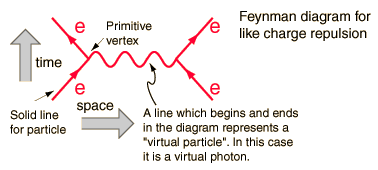
Virtual particles live only within integration limits, they have the quantum numbers of the named particle but their mass is off shell, within the limits of the implied integration.
When they pop back out of existence do their mass disappear instantly?
They do not exist outside integration limits, which supply the energy for the interaction. If you are thinking of vacuum loops of pair produced particle antiparticle, they can only exist in corrections to real particle interactions. If no real particles supply four vectors for the interaction, there are no observable virtual particles.
BTW what is the heaviest virtual particle ever found?
Virtual particles cannot be observed. They can be stated as a mathematical hypothesis, but their mass has to be within the limits of the integration.
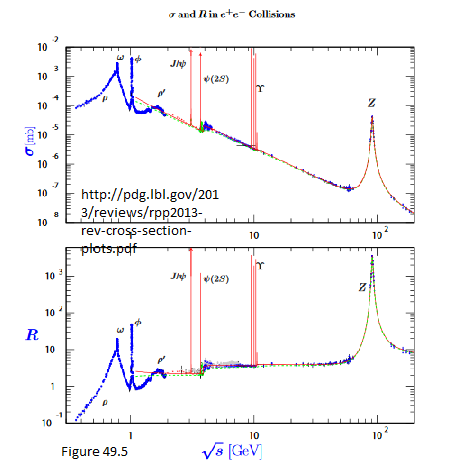
In e+e- annihilation , the closer to the mass of the Z the incoming energy is, the closer the virtual Z is to the on shell mass of 90+ GeV of the Z.
Subscribe to:
Posts (Atom)
-
A rook stands in the lower left corner of an $m\times n$ chessboard. Alice and Bob alternately move the rook (horizontally or vertically, th...
-
At room temperature, play-dough is solid(ish). But if you make a thin strip it cannot just stand up on it's own, so is it still solid? O...
-
I am researching Mercury's orbital precession. I have considered most perturbations and general relativity. I am still not satisfied. I ...
-
The gravitation formula says $$F = \frac{G m_1 m_2}{r^2} \, ,$$ so if the mass of a bob increases then the torque on it should also increase...
-
(The puzzle statement now identifies these numbers as equivalent.) O O ...
-
Small vessels generally lean into a turn, whereas big vessels lean out. Why do ships lean to the outside, but boats lean to the inside of a ...
-
Can someone explain the difference between hopping and tunneling? The context I'm considering is conduction in semiconductors, specifica...
