Monday, 4 March 2019

newtonian mechanics - If Earth starts moving when attracted by an object, where does the energy come from?


Suppose a body(very big but not bigger than Earth) moves against gravitational force of Earth. The force will do negative work on the body decreasing its kinetic energy. The decreasing energy is converted to potential energy. Now as gravitational force is mutual and also due to Newton's third law of motion, the body will exert force equal to its weight on Earth and will do positive work on it. The Earth,though very big, will accelerate slightly towards the body. As it is accelerating , kinetic energy of it is increasing. According to Law of Conservation of energy, the increasing kinetic energy is not created; it must be transferred to this form from other. So, from where does the Earth get this increasing kinetic energy??? Please help.


[ I think the increasing kinetic energy of the Earth comes from the potential energy of the body-Earth system. Thus it is the kinetic energy lost by the body when ascending upwards against the gravitational force cum the potential energy that supplies the kinetic energy of the accelerating Earth and energy is conserved hence. Am I right? If not, why??]


Answer


Suppose a body(very big but not bigger than Earth) moves against gravitational force of Earth.


Let us take a real situation: a large rocket is fired straight up. It takes kinetic energy from the chemical explosions; from momentum conservation part of the available energy from the explosion moves the earth in the opposite direction.


The gravitational force will slow down the rocket, but viewed in the center of mass system of the two bodies both the earth and the rocket will be slowing down because of their mutual attraction.


The force will do negative work on the body decreasing its kinetic energy.


OK


The decreasing energy is converted to potential energy.


Yes.


Now as gravitational force is mutual and also due to Newton's third law of motion, the body will exert force equal to its weight on Earth and will do positive work on it.


The Earth,though very big, will accelerate slightly towards the body.


Hmm, no. The earth and rocket initially are accelerating away from each other due to the explosion, and then will both start decelerating until the zero momentum is reached for both, and the maximum of potential energy i.e. maximum separation, then they will accelerate towards each other, the rocket will fall .


As it is accelerating , kinetic energy of it is increasing.


According to Law of Conservation of energy, the increasing kinetic energy is not created; it must be transferred to this form from other. So, from where does the Earth get this increasing kinetic energy??? Please help.


From the original explosion. The original explosion released energy divided between earth and rocket, then because of the dynamics it turned into potential energy at the peak of the trajectory, and then because of the unimpeded attraction, turned again into kinetic energy as the earth and rocket accelerate towards each other and meet with a bang.


Edit after comment:


Note that nothing can move against the gravitational pull of each other, as gravitation is always attractive, unless outside energy is provided .


Let us take the hypothetical case that two objects, far away from other gravitational fields are at a distance r, at rest with each other by coincidence of the dynamics of the creation of the cosmos. Then it is true that due to their gravitational attraction their potential energy will turn into kinetic energy as they fall at each other. The energy originally to be found at this position at rest with each other was provided by the original creation of these two objects, i.e. the Big Bang energies in the BB model.

What is the closest general-relativistic equivalent of a "time slice"?


In a newtonian universe, one can talk of a "time slice", that is, the state of the universe at a given point in (global) time. In a "typical" classical universe, a time slice would contain enough information to fully compute the state of the universe at any other point in time, backwards or forwards.


So, disregarding what we know of quantum effects and talking purely of a general-relativistic universe, which concept is closest to a time slice?


Answer


The actual equivalent to a Newtonian "slice of time" in GR is a "space-like hypersurface". It is a 3 dimensional hypersurface in 4D space-time (hence the hypersurface). It is "space-like" because any two points are connected by a "space-like" path in the metric. This means that they are independent from a causality perspective, and can form the basis of forward predictions.


If this is a global hypersurface (ie doesnt just stop somewhere, or miss out regions) then it is called a "Cauchy surface".


As remarked elsewhere there is more choice in GR involved. The simplest way to see this is to note that Newtonian theory is $E^4$ with (x,y,z,t) and once t= const is chosen at the space origin, say, the entire hypersurface is now determined.


In say Minkowski space (the nearest GR equivalent to Newtonian space) there is a choice of timelike vector to be made first. There are 4 degrees of freedom here, but there is the timelikeness restriction and the restriction on time direction. (Physically this is a choice of Inertial Frame.) This allows a foliation to form. To obtain an actual hypersurface (hyperplane in this case) we can choose one point P on that hypersurface (ie a specific time in the Frame). Now the timelike vector is a normal to that hyperplane and we can determine whether an arbitrary point (x,y,z,t) is on that hyperplane. There will be 3 degrees of freedom as expected.


GR generalises the Minkowski example in that the hypersurface might be curved and not flat, requiring an infinite number of independent points to identify it.


One further generalisation is that in Relativity we have a metric which allows null distances between different points. Thus we can have a "null hyperplane" and "null hypersurface" too, which are quasi-generalisations of the timelike slice Newtonian idea.


quantum mechanics - How to derive Schrödinger equation?


How is the Schrödinger equation


$$ i\hbar\frac {\partial }{\partial t}\psi=H{\psi }$$


derived?


photoelectric effect - What's the difference between the work function and ionisation energy?


In a particular textbook, the work function of a metal (in the context of the photoelectric effect) is defined as:


the minimum amount of energy necessary to remove a free electron from the surface of the metal


This sounds similar to ionisation energy, which is:


the amount of energy required to remove an electron from an atom or molecule in the gaseous state


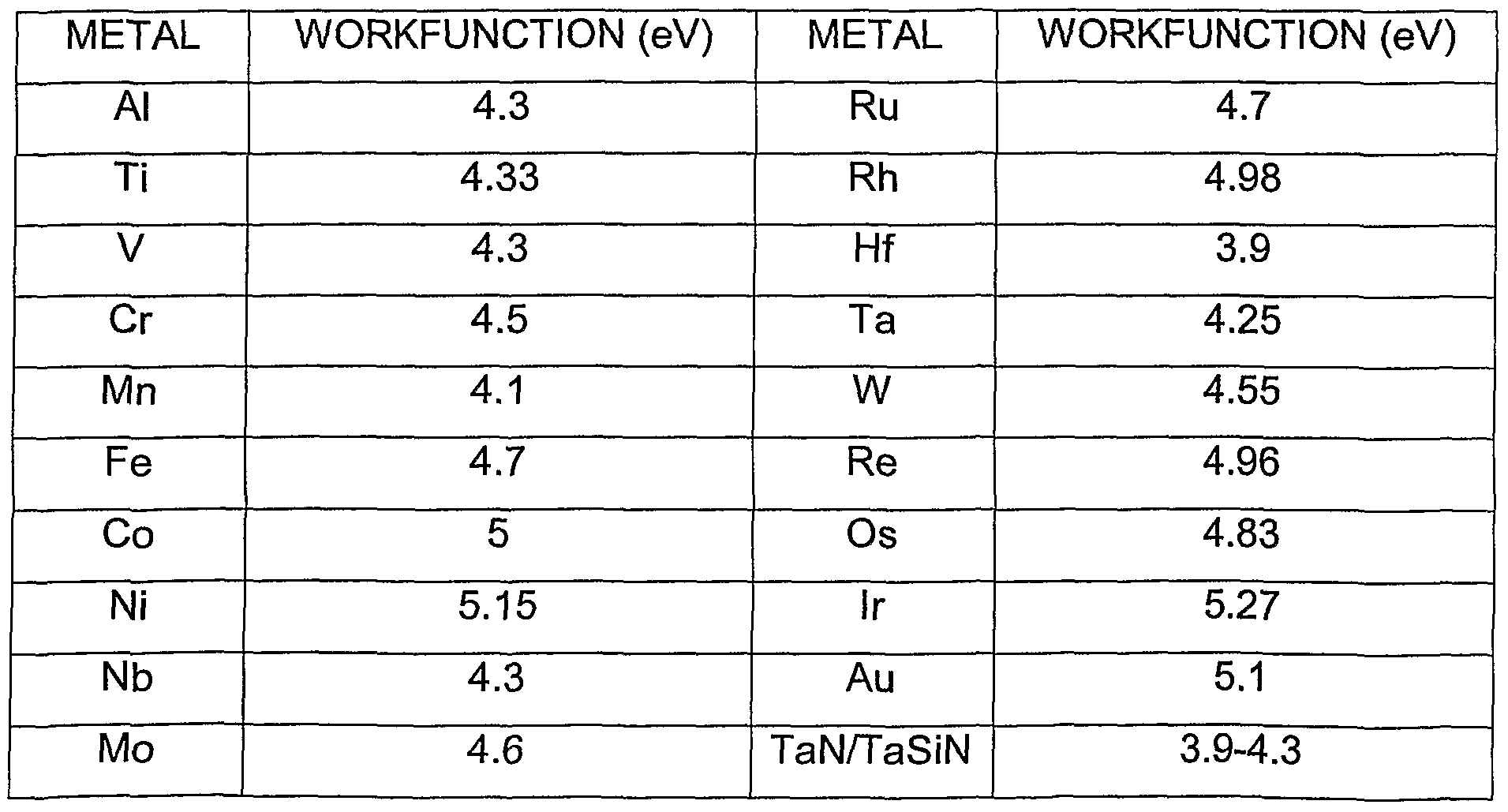
These two energies are generally different. For instance, Copper has a work function of about 4.7eV but has a higher ionisation energy of about 746kJ mol-1 or 7.7eV.


I've sort of figured it's because the work function deals with free electrons whilst ionisation is done with a valence electron still bound within the atom. Is the difference due to the energy required to overcome the attraction of the positive nucleus?


Answer


On first reading they do sound similiar, but they are entirely independent energies and concepts.


The work function of a metal refers to the minimum energy required to release an electron from the surface of a metal by a photon of light. The work function will vary from metal to metal. You might have a read of these: Compton Effect, this previous answer, Work function 1 and this Wikipedia article Work Function 2.


enter image description here


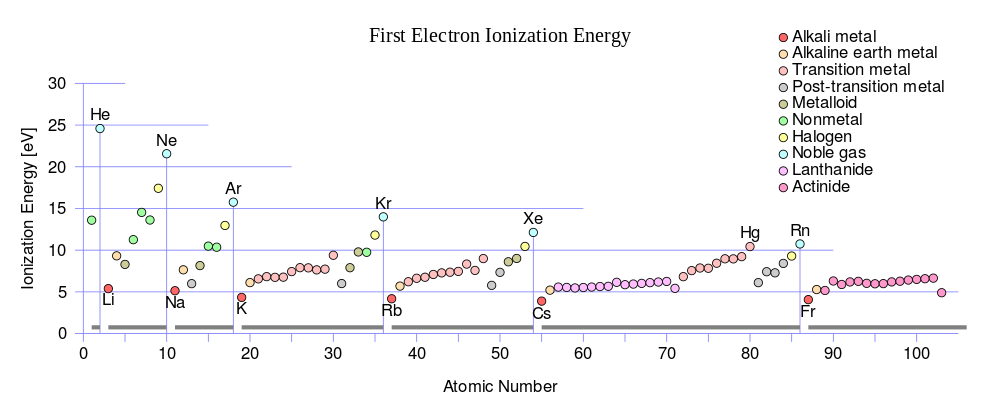
The Ionization energy is the energy needed to release electrons from their bound states around atoms, it will vary with each particular atom, with one outer electron around that atom needing less energy to release it than a lower, more closely bound electron, which requires greater energy because of the greater electrostatic force holding it closer to the nucleus.


Also, to complicate things, you need to allow for the Shielding Effect of Inner Electrons


enter image description here


Periodic trends for ionization energy (IE) vs. proton number: note that within each of the seven periods the IE (colored circles) of an element begins at a minimum for the first column of the Periodic table (the alkali metals), and progresses to a maximum for the last column (the noble gases) which are indicated by vertical lines and labelled with a noble gas element symbol, and which also serve as lines dividing the 7 periods. Note that the maximum ionization energy for each row diminishes as one progresses from row 1 to row 7 in a given column, due to the increasing distance of the outer electron shell from the nucleus as inner shells are added.


Sunday, 3 March 2019

resonance - Phase difference of driving frequency and oscillating frequency


Suppose a mass is attached to a spring and is oscillating (SHM). If a driving force is applied, it must be at the same frequency as the mass' oscillation frequency. However I'm told that the phase difference between the driving frequency and the mass's frequency must be $\frac{\pi}{2}$.


Why is that? I would have thought they should have to be in phase to be in resonance?


Answer


It would depend on damping effects being taken into account or not.


Invoking Newton's 2nd Law of motion, a differential equation for the motion of a damped harmonic oscillator can be written (including an external, sinusoidal driving force term):


$m\frac{d^2x}{dt^2}+2m\xi\omega_0\frac{dx}{dt}+m\omega_0^2x=F_0\sin\left(\omega t\right)$


Where $m$ is the inertial mass of the system, $\omega_0$ is its characteristic frequency, $\xi$ a dimensionless damping factor... And, last but not least, where $F_0$ is the amplitude of the driving force and $\omega$ its frequency.


The stationary ($t\rightarrow\infty$) solution takes the shape $x\left(t\right)=A_0\sin\left(\omega t-\varphi_0\right)$, where $A_0$ is an amplitude factor (whose particular expression in terms of the particular parameters is not relevant to this question) and $\varphi_0$ is phase lag, which is this phase difference you are asking about.


This phase difference can be calculated to be $\varphi_0=\left|\arctan\left(\xi\dfrac{2\omega\omega_0}{\omega^2-\omega_0^2}\right)\right|$. It is a phase lag, so with the (implicitly) chosen phase convention, it has to be positive.


If there was no damping whatsoever in the system, $\xi$ would be zero, and you would be right: $\varphi_0=0$. The stationary motion of the oscillator would be in phase with the driving force (regardless of which is the relationship between $\omega$ and $\omega_0$).


But in an undamped resonant situation the amplitude $A_0$ diverges, which means that the stationary solution is never reached (starting from reasonable, finite initial conditions for the system). Also, in a physical down-to-earth situation, the system would eventually breakdown somewhere, somehow, since energy is being introduced into the system with perfect efficiency (that is what 'resonance' is all about) and without any means to dissipate it. Somewhere, sooner or later, something would go boom or crash. That is how nasty undamped resonances are.


On the other hand, for a non-zero damping, in the resonant case $\omega=\omega_0$, the argument of the $\arctan$ function diverges, so the phase difference turns out in this case to be $\frac{\pi}{2}$.


To sum up, the $\frac{\pi}{2}$ phase appears as an effect of damping in the system, and just a little bit of it is enough to offset the oscillatory response from the system. As it happens, every realistic, down-to-earth harmonic system has some kind of damping in its dynamics. Even if the damping is so small that the induced dephasing in an out-of-resonance situation is negligible for every purpose that the model has, damping has to be taken into account in resonant and closely resonant motion, otherwise the model yields highly unphysical results.


gauge theory - Counting number of degrees of freedom in constrained system


Following Counting degrees of freedom in presence of constraints, we know that there would be N-2M-S dofs if we have M 1st-class constraints and S 2nd-class constraints in N-dim phase space.


I don't know how we come up with this counting. Why does each 1st-class constraint eliminate 2 dofs and each 2nd-class constraint eliminate 1 dof?


Thanks.


Answer


A first-class constraint eliminates 2 degrees of freedom because it, one the one hand, relates the $p_i$ and the $q^i$ with an equation, and on the other hand generates a one-parameter group of gauge transformations on the constraint surface, where all states lying in the same orbit have to be physically identified. So you lose one d.o.f. because of the constraint equation itself, and one further d.o.f. because of the gauge transformation generated.


A second-class constraint does not generate a gauge transformation, the transformation generated by it does not have physical meaning because it does not preserve the constraint surface - it maps a state on the surface to a state off the surface. So for a second-class constraint, you only have the single degree of freedom it eliminates simply by being a relation among the coordinates.


quantum mechanics - What is the physical sense of the transition dipole moment?


So if the states are the same we achieve the expectation value of the dipole moment for a given state. I mean


$ \langle \mathbf{\mu} \rangle = \langle \psi \vert \hat{\mathbf{\mu}} \vert \psi \rangle$


But I don't feel the physical sense in the case of transition dipole moment when psi-functions on both sides are different


$\langle \psi_{1} \vert \hat{\mathbf{\mu}} \vert \psi_{2} \rangle$


Help me to understand, please.


Understanding Stagnation point in pitot fluid

What is stagnation point in fluid mechanics. At the open end of the pitot tube the velocity of the fluid becomes zero.But that should result...