Wednesday, 24 December 2014

cipher - A not very easy puzzle with an easy answer. Something that a grim puzzler might like


1f411


pirate gibberish


00000010


1f607


.


1f441


1f44f


1f411


.


Cigarette ___


lion's-bane@


ワs


22 2


65 61 73 79


160 141 162 164


"2" & right(getMethod("mixintowater"), 5)


9 (4*2) 2 8 _ (4*3) (7*4) _ 6 (9*3) _ (6*2) 2 6 (3*2)?


Hint:


Unicode, guess, binary, Unicode - Unicode, Unicode, Unicode - guess, guess+symbols,Japanese,chemistry, ASCII, ASCII, code - ...


Answer


The last line is a telephone cipher.


A regular telephone keypad looks like this:


+-----+-----+-----+
| | ABC | DEF |
| | | |
| 1 | 2 | 3 |
+-----+-----+-----+
| GHI | JKL | MNO |
| | | |

| 4 | 5 | 6 |
+-----+-----+-----+
| PQRS| TUV | WXYZ|
| | | |
| 7 | 8 | 9 |
+-----+-----+-----+
| | | |
| * | 0 | # |
| | | |
+-----+-----+-----+


Given a character in the code, if there is just a single number (e.g. 2), you press that key once, to give the first letter on that number (i.e. A). If the character is a number "times" some other n (e.g. "7*4"), you press the key n times to get the nth letter for that number (i.e. S).


Doing so, you get the message:


WHAT IS MY NAME?


Which is, of course, Brent Hackers.


quantum mechanics - Probability conservation in WKB tunneling


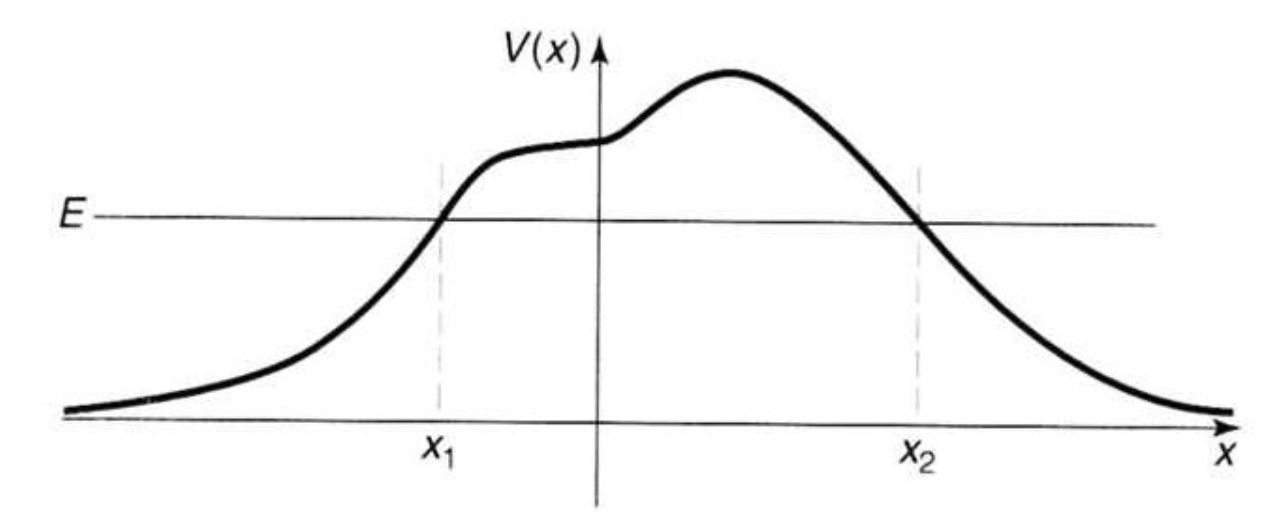
Suppose we have quantum mechanical plane waves of energy $E$ incident upon a one-dimensional potential barrier $V(x)$ with sloping sides.


enter image description here


One can compare the WKB solutions in the three relevant regions to asymptotics of the Airy function solutions to the linearized Schrödinger equation near the turning points to obtain matching formulae, relating $A, B$ (the coefficients of the right- and left-propagating waves, respectively, left of the barrier) to $F, G$ (the coefficients of the right- and left-propagating waves, respectively, right of the barrier). One can then construct the relevant scattering matrix $S$, defined by:


$$\left[\begin{array}{c} B\\ F \end{array}\right]=S\left[\begin{array}{c} A\\ G \end{array}\right] \, .$$


I have carried out the above computation and found that


$$S=\left[\begin{array}{cc} i\left(\dfrac{1-4e^{2\gamma}}{1+4e^{2\gamma}}\right) & \dfrac{4e^{\gamma}}{1+4e^{2\gamma}}\\ \dfrac{4e^{\gamma}}{1+4e^{2\gamma}} & i\left(\dfrac{1-4e^{2\gamma}}{1+4e^{2\gamma}}\right) \end{array}\right]$$


where


$$\gamma=\frac{1}{\hbar}\int_{x_{1}}^{x_{2}}\sqrt{2m\left[V\left(x\right)-E\right]}dx$$


measures the "strength" of the reflecting, classically-forbidden region.


This scattering matrix $S$ is in fact unitary, and hence this scattering process conserves the probability current across the barrier. But why should this be true?


I know that a solution of the Schrödinger equation will necessarily conserve probability current, but here we have both (1) assumed approximate WKB-type solutions and (2) carried out a complicated asymptotic matching procedure. It is not clear to me why, after this approximation and matching procedure, the resulting solution should still conserve probability current.


Said another way: is there an a priori reason one should expect the WKB-matched solutions to conserve probability current (in spite the fact that they are inexact), or is this simply a happy coincidence that falls out of the computation?


cipher - Decode the message enciphered in these symbols: ↗↑↙↓↘←↑↙↘↘↗↓↗←↙↓↖


↗↑↙↓↘←↑↙↘↘↗↓↗←↙↓↖


The first character of the plaintext is 'P'. The final character of the plaintext is 'E'.


Hint 1;


The second word of the plaintext is DISPUTE.


Hint 2:


NW = 'end of message'. It's an end-of-file marker.


Details (not part of the puzzle):


  • "↗↑↙↓↘←↑↙↘↘↗↓↗←↙↓↖" is the cyphertext. What is the plaintext?


  • The answer is a clue to The Security to the Party [12] (now with party soundtrack!)


  • This type of puzzle is called a Cryptogram. The Google search "How to solve a cryptogram" leads to all kinds of useful resources, hints and tips.


  • The answer is a pair of dictionary words in the English language. The puzzle is not case-sensitive. The plaintext does not contain any slang or acronyms, it does not contain any proper nouns (names), it does not contain roman numerals, it does not contain punctuation or spaces.


  • For anyone who's having trouble with fonts, and for accessibility: the cyphertext is a series of Unicode arrows pointing in different directions. The sequence is: NE N SW S SE W N SW SE SE NE S NE W SW S NW


  • Chat about this puzzle is here: http://chat.stackexchange.com/rooms/18676/pick-up-sticks I'll be popping in and out. Feel free to ask any questions there or in comments.


  • On some screens it looks like some of the arrows are in bold and some aren't. That is not the intention, it's just the way the fonts look. If you use the list of compass points above then you are at no disadvantage.


Update: Argh! I was so busy doing the cipher that I didn't notice the spelling mistake in the plaintext. Well done to nexolute for solving anyway! Future readers beware that the first word of the puzzle is (unintentionally) not a dictionary word, because it has a spelling mistake in it. Are my cheeks red!


Answer


Going in clockwise, ignoring NW, we get the following...


N  : AHOV
NE : BIPW
E : CJQX
SE : DKRY

S : ELSZ
SW : FMT
W : GNU

And let NW be the EOF character. Now this is where I'm bad with, how can we construct the final solution from these?


Using regular expression dictionary, I didn't manage to find anything, so I reduce to search with less characters and get use a little guess and check to get PATERNATY DISPUTE (should it be paternity dispute?). Not so sure if this is right?


particle physics - To what extent are lepton and quark generations tied in the Standard Model?


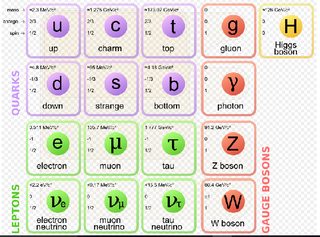
The Standard Model of particle physics splits both the leptons and the quarks into three generations, with mass and instability going up from the first to the third generation. These are normally displayed together, on the same rows or columns of the table of fundamental particles:


This makes some sense: each charged lepton is tied to its neutrino in most Feynman vertices it appears in, and the quarks are linked to each other by their charges, if nothing else. However, I can't think of any way in which the SM formally links, say, muons and strange quarks. It's there some explicit link with generation-specific interactions? Or is it just coincidence that there's three rungs in both ladders with increasing mass on both?


visualization - Difficulty in visualizing more than three spatial dimension


Is there is any other way than abstract mathematics to visualize higher dimensions. Physicists working in high energy physics live in higher dimensions (pun intended), with their sophisticated mathematical tools they easily work there way out in higher dimensions. Take for a simple example of a $n$-sphere $S^N$ http://en.wikipedia.org/wiki/N-sphere.


  • 0-sphere $S^0$ is a pair of points ${c − r, c + r}$, and is the boundary of a line segment (the 1-ball $B^1$).


  • 1-sphere $S^1$ is a circle of radius $r$ centered at $c$, and is the boundary of a disk (the 2-ball $B^2$).

  • 2-sphere $S^2$ is an ordinary 2-dimensional sphere in 3-dimensional Euclidean space, and is the boundary of an ordinary ball (the 3-ball $B^3$).

  • 3-sphere $S^3$ is a sphere in 4-dimensional Euclidean space.


The problem is how hard I think it is impossible for me to visualize a 3-sphere.


cosmology - The range of light


It occurs to me that the empirical evidence shows that there is a point out in space where light stops coming from.


Putting aside the expansion of the universe for a second, and focusing strictly on the evidence:


  • what would the universe look like if light had a finite range?


  • isn't that what the universe looks like?


Recall Hubble's Law,$ v = H_0D$


The range of light is $H_0 D = c$


Also recall that Edwin Hubble stressed the point that $v$ is apparent recessional velocity. It is the apparent recessional velocity, not the actual recessional velocity. He proposed that rather than Doppler shifts, these redshifts are a "new principle of nature".


Ignoring the theories and strictly examining the empirical evidence, does it make sense that light could have a finite range?


Tuesday, 23 December 2014

particle physics - Naive question on quantum mechanics and uncertainty principle


This is a follow up on this question, the answer of which points towards Quantum Mechanics.
As stated I am not a phycisist so please forgive my ignorance.

I will try to understand the issue by going in small steps (questions).
Wiki says:


In quantum physics, a quantum vacuum fluctuation (or quantum fluctuation or vacuum fluctuation) is the temporary change in the amount of energy in a point in space,1 arising from Werner Heisenberg's uncertainty principle


My question here is the following (actually has 2 parts):
1) The statement the temporary change in the amount of energy is what is meant when I read (and in the answer in my previous post) that things pop out of "nothing"?
2) Reviewing the uncertainty principle in wiki the concept (as I am capable of understaning it) is that we can not know both the position and the direction of a particle/object at the same time.How can from this conclude that things can come up out of "nothing ? It is not clear to me.
If we can not know where a particle currently is since we are looking into another property of it i.e. momentum then if we start looking into its position then does that mean that it appears out of "nothing"?
If someone could help me understand this in lamens terms it would be much appreciated.


Answer


Taking the first part of your question first: how do we get the energy-time uncertainty from the position-momentum uncertainty? This turns out to be surprisingly difficult to do rigorously. Even Heisenberg was only able to give an approximate derivation of it (based on a property called Compton wavelength). I found some of rigorous derivations here, here and here, but these are utterly impenetrable for the beginner. Even the Compton wavelength argument is a bit involved, so what I'm going to give is a justification based on dimensional analysis. This doesn't prove the energy-time uncertainty relation, but it shows it is plausible.


The Heisenberg uncertainty principle relates position and momentum. Position has units of distance, e.g. metres, and from basic mechanics ditsance is velocity times time:


$$x = vt$$


Momentum has units of mass times velocity:


$$p = mv$$


So if you multiply together position and momentum (as the Heisenberg UP does) you get:


$$x \times p = vt \times mv = t \times mv^2$$


I've rearranged the right hand side slightly because kinetic energy is $1/2mv^2$, so the right hand side looks like time times energy i.e.


$$x \times p = t \times E$$


NB this doesn't prove that $\Delta x \Delta p = \Delta t \Delta E$ but it shows that it's plausible.


Now onto the second part of your question (assuming I've convinced you that the energy-time UP follows from the position-momentum UP).


First let's ask is the energy-time UP real. Yes it is, and we can observe it fairly easily. You've probably heard that if you excite an atom it will emit light as it returns to it's ground state, and the frequency of the light emitted depends on the energy difference between the excited and ground states. This creates the atomic spectrum, which is routinely used for identifying atoms. Helium was first identified in the atmosphere of the Sun using this technique. Anyhow, the lines in the atomic spectrum don't have a precise frequency. If you measure them carefully you'll find they span a range of frequencies. Part of the broadening is from mundane sources like the doppler shift, but part arises from the E-t uncertainty principle.


So the E-t uncertainty principle is real, and it means we can't be certain about the energy of an atom unless we watch it for an infinite time. But exactly the same argument means that if we take some patch of vacumm we can't be certain about it's energy unless we watch it for an infinite time. That means the energy of the vacuum must fluctuate i.e. energy must spring into existance from nothing.


You may still be a bit unconvinced, but we can actually measure this spontaneous creation in the vacuum using the Casimir effect, so we know it really happens.


Hopefully by now you're convinced about (temporary) creation from nothing, and I guess your next question is precisely what happens when a virtual particle is created. Sadly I can't give you an answer for this. We have mathematical models for the process, like Quantum Field Theory, but whether this is what eally happens, or even if "what really happens" is a meaningful question, I don't know.


Response to comment: this links up with my answer to your other question, What is meant by "Nothing" in Physics/Quantum Physics?, so I thought I'd expand this answer rather trying to put everything in comments.


Anyhow, you ask a fair question. I've taken the position that the vacuum is effectively nothing plus the vacuum fluctuations, and you're asking me how I know it's not something plus the vacuum fluctuations. Actually this is sort of where we came in with your first question in the series.


My answer is that we can do experiments on the vacuum to see what's there. For example we can measure the vacuum fluctuations using the Casimir effect, and we get the answer our theory predicts. We can shine light through the vacuum to see if there's anything there, and we can weigh the vacuum (i.e. see if the vacuum has any gravitational attraction). In all cases we get the results our experiment predicts, and that's why I say the vacuum is effectively nothing plus the vacuum fluctuations.


You could argue that there is something present that we haven't worked out how to detect yet, but without any theoretical backing for this it's like saying there are fairies at the end of the garden that we haven't worked out how to detect yet!

Understanding Stagnation point in pitot fluid

What is stagnation point in fluid mechanics. At the open end of the pitot tube the velocity of the fluid becomes zero.But that should result...