Wednesday, 6 March 2019

spacetime - If mass density curves space-time, then why isn't density (at each $x$, $y$, $z$) considered a dimension in space-time?


From http://science.howstuffworks.com


"Theodor Kaluza theorized that a fourth spatial dimension might link general relativity and electromagnetic theory. But where would it go? Theoretical physicist Oskar Klein later revised the theory, proposing that the fourth dimension was merely curled up, while the other three spatial dimensions are extended."


We know high mass density creates gravitational waves that compress length and time (relative to an observer at lower ambient gravitational waves). Why not include density as a dimension in space-time?


Answer


Because it doesn't add another term to the length element?


One way to understand the dimensionality of space is to examine the nature of the length element. In three dimensional space (and with a Cartesian basis) it is $$ (\Delta s)^2 = (\Delta x)^2 + (\Delta y)^2 + (\Delta z)^2 \;, $$ which you will note has three terms. In four-space it would be $$ (\Delta s)^2 = (\Delta w)^2 +(\Delta x)^2 + (\Delta y)^2 + (\Delta z)^2 \;. $$


Density doesn't add a term to the length element, instead it effects the coefficients of the sum. Something like $$ (\Delta s)^2 = c_x(\Delta x)^2 + c_y(\Delta y)^2 + c_z(\Delta z)^2 \;, $$ with no guarantee that the $c$'s are unity. That's a different kind of modification to the meaning of space.


Aside: This kind of definition has a couple of nice features. First, it extends smoothly to include intervals in Minkowski space or the more generalized space of general relativity. Second it allow a clear explanation of why the proposed compact dimensions of string theory don't appear to effect physics at human (or even nuclear) length scales.


quantum mechanics - Why is argon a noble gas but not, say, beryllium or palladium?


Why is argon a noble gas given that the 3d subshell is still empty? More generally, why is it that the filling of a p sub-shell makes an element noble rather than s, d, or f sub-shells, or completed n-levels?


Let's start with the prior that in a hydrogen atom the principle quantum number determines the energy - so maybe full shells correspond to noble gases.


Now, I understand that in helium the n=1 level is full, so it is a noble gas. Then, beryllium has a full 2s subshell, but empty 2p, so it is a metal. Neon has the n=2 level full, and is a noble gas. Magnesium has a full 3s subshell, but not a full n=3 level and is a metal - so far so good. But, oops, argon has full 3s and 3p subshells but empty 3d, yet it is a noble gas.


At this point we look at the aufbau principle and say "ah, your prior is no good, the 4s is lower energy than 3d, and this is the first time it has kicked in - so there you go". But, as we continue down the periodic table there are more noble gasses and they happen only with the filling of a p subshell. Why is krypton noble, but not zinc? Even palladium cleanly fills n=4 up through 4d (with only 4f empty) but it is still not a noble gas. Ytterbium fills an f subshell for the first time and it isn't noble. What makes the filling of a p subshell so specially inert compared to s, d, and f subshells?


The aufbau principle does not explain this. Draw the classic "diagonal aufbau chart" and circle where the noble gasses are. It doesn't add any insight. Noble gasses only happen when you fill a p subshell. Why?


Answer


Aufbau arises mainly from the fact that the screened potential is not the same as the $1/r$ potential of hydrogen. In the screened potential, some levels are pushed up in energy and some are pushed down. Basically the high-l orbitals have less probability concentrated near the nucleus, where the screened potential is the most negative, so they're pushed up in energy relative to the low-l orbitals.


In addition to this, you get effects that are the way they are not because of any semiclassical argument because of the way the Schrodinger equation works. You're basically diagonalizing a big matrix, and there is no guarantee that the results will come out to be easy to explain. Sometimes such results can be at least partially described by heuristics, such as a tendency for energy levels to "repel" each other, although it's not actually a physical repulsion. For this "level repulsion" to happen, the levels have to have the same angular momentum. (It's actually pretty surprising that this kind of level repulsion leaves the $n$ shells degenerate in hydrogen. You would think it would split them up.)


Noble gases exist when there is a large gap between the single-particle energy levels. These gaps do not occur for the screened potential at the same particle numbers where they would occur for hydrogen.


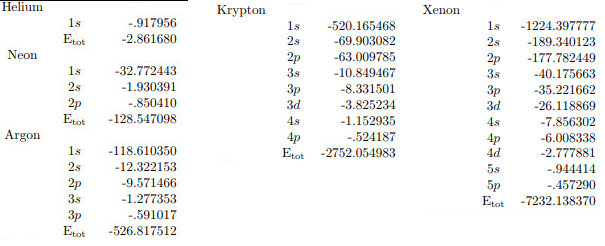
Here are some energy levels of states in noble gases, calculated using the Hartree-Fock method, from Johnson, Lectures on Atomic Physics, p. 86:


table of Hartree-Fock energy levels for noble gases


The Hartree-Fock method calculates the energies self-consistently for a particular atom, so the energies are different for the different atoms. It would be convenient to have the calculation for something like potassium, so we could see the gap between the last filled state in argon and the final electron for potassium, but he doesn't actually give those. However, you can clearly see the relevant shell gap in the calculation for krypton. There is a gap of 4.5 Ha between 3p and 3d. This is considerably larger than the gap between 3s and 3p (2.5 Ha) and between 3d and 4s (2.7 Ha).


So - what is special about p sub shells such that when they fill there is a larger gap up to the next level than when s,d, or f sub shells fill?


There is nothing special about p shells. These calculations are based on diagonalizing a big matrix. There is no particular reason to expect the spacing between subshells to follow any simple rules.


Beryllium isn’t a noble gas.


If you look at the levels for argon, you can see that the gap between 2s and 2p is less than 3 Ha, while the gap between 2p and 3s is about 8 Ha. The reason for the sizes of the gaps is ultimately just that that's what you get when you diagonalize the matrix. However, I don't find the result particularly surprising, since the unscreened potential has 2s degenerate with 2p, and a big gap between 2p and 3s.


nuclear physics - gamma ray lasers?


Is it really possible in the foreseeable future to create a gamma ray laser? I've read these two articles on Wikipedia:


the Hafnium controversy


Induced gamma emission


It sounds pretty amazing, although apparently no one has reproduced the phenomenon since 1998...


homework and exercises - Transmission of Gaussian Beam Through Graded-Index Slab


The $ABCD$ matrix of a glass graded-index slab with refractive index $n(y)=n_0(1-\frac{1}{2}\alpha^{2}y^{2})$ and length $d$ is $A=\cos(\alpha d)$, $B=\frac{1}{\alpha}\sin(\alpha d)$, $C=-\alpha \sin(\alpha d)$, $D=\cos(\alpha d)$ for paraxial rays along the z axis. Usually, $\alpha$ is chosen to be sufficiently small so that $\alpha^{2}y^{2} << 1$. A Gaussian beam of wavelength $\lambda_0$, waist radius $W_0$ in free space, and axis in the z direction enters the slab at its waist. How can I use the $ABCD$ law to get an expression for the beam width in the $y$ direction as a function of $d$?


Answer


The ABCD law can be used for Gaussian beam propagation using the complex beam radius $q$. Defining $\frac{1}{q} = \frac{1}{R}-i\frac{2}{kW^2}$, $R = R(z)$ being the radius of curvature of the beam and $W = W(z)$ the halfwidth at point $z$ and $k = 2\pi/\lambda_0$, the complex beam radius transforms as $q \to \frac{Aq+B}{Cq+D}$. In your case (waist at the beginning of the medium, radius of curvature at the waist being infinite), so that $q = ikW_0^2/2$ at the front of the medium.


fluid dynamics - How is pressure an intensive property?


I've seen this question asked before but I can't find an answer to the specific point I'm troubled with. From the kinetic theory of gases, pressure results from molecules colliding with the walls of a container enclosing a gas, imparting a force upon the wall. Now, if we split the container into two halves, I am told that pressure remains the same on either side of the partition assuming the gas has uniform density throughout the container. But If we split the container into two, isn't there effectively half the number of molecules striking the wall on each side so the pressure should also be halved? Shouldnt pressure be dependent on the number of molecules?


Answer


If we split the container into two, isn't there effectively half the number of molecules striking the wall on each side so the pressure should also be halved? Shouldnt pressure be dependent on the number of molecules?


You are right that if we only halved the number of particles we would have a smaller pressure. But you have also halved the volume of the container. The fewer number of particles hits the walls more frequently due to the smaller volume. In other words, the number of particles goes down, but the number of collisions per particle goes up. The two effects cancel out, leading to the same pressure as before you put in the partition.


Monday, 4 March 2019

quantum mechanics - How to find that a molecule has zero spin?


I read that Ne has $S=0$. How can this be found, knowing the electron configuration?


Electrons, protons and neutrons all have 1/2 spin. The Pauli exclusion principle implies that the even number of electrons are half up-spin and half down-spin, so that they sum to 0. Is that argument valid, and if so, can the same be applied to show that the total spin of neutrons and protons, which occupy the same space, is 0?


I suppose that would imply that $S=0$ for all molecules with even numbers of electrons and protons+ńeutrons.


Answer


If you stick to atoms, and use the atomic orbital approximation, it's easy to work out the electronic spin by working out what atomic orbitals are populated. The atomic orbitals are populated in a slightly strange order that's given in http://en.wikipedia.org/wiki/Electron_configuration#Aufbau_principle_and_Madelung_rule. You have to remember that the p orbitals are really 3 orbitals of equal energy, the d orbitals are 5 orbitals of equal energy and if you get as high as the f orbitals there are 7 of these.


So hydrogen with 1 electron is 1s$^1$ and has spin half. helium is 1s$^2$ and the spins pair so you get spin zero. Likewise Lithium is 1s$^2$2s$^1$ with spin half and Beryllium is 1s$^2$2s$^2$ with spin zero. But take Carbon, which is 1s$^2$2s$^2$2p$^2$. It looks as if the spin should be zero because you have an even number of electrons. However the two p electrons will not be in the same p orbital because there are three p orbitals with equal energy. Because the p electrons are in different orbitals their spins are not necessarily paired, so the spin could be zero or it could be one. As a general guide Hund's rule tells you the higher spin is favoured, so the electronic spin of the carbon would be one (actually I can't remember if this is true or not).


Neon is 1s$^2$2s$^2$2p$^6$ and has spin zero because there are two electrons in each of the 1s, 2s and all three 2p orbitals, so the spins are all paired.


For molecules you proceed in a similar manner but you have to fill the molecular orbitals. It's rarer to get degenerate molecular orbitals since molecules don't have the spherical symmetry of atoms.


I'm not sure why Boris is telling you to ignore nuclear spin. True, it doesn't play any role in chemistry, but it is important in the spectra of atoms. In fact interactions between the electronic and nuclear spin are responsible for the Hydrogen 21cm radiation, and there's a lot of that in the universe!


tensor calculus - Introduction to spinors in physics, and their relation to representations


First, I shall say that I am familiar with the intuitive idea that a spinor is like a vector (or tensor) that only transforms "up to a sign" when acted on by the rotation group. I have even rotated a plate on my palm to explain this to my fiancee! I have also looked at spinors as mathematical objects, such as the 2d subspace of complex 3-space such that $X·X = 0$, and feel that I understand this well also.


I am confused by spinors in physics. Are they still vectors that are isotropic (inner product with themselves is 0)? In what vector space? Normally states are vectors in infinite dimensional spaces! Every attempt to find literature which pins down specifically what a spinor is (in physical terms) seems to assume that one is already well acquainted with the idea.


Take, for example, the Dirac equation. I can see that the solutions are four-component wavefunctions, which then splits into two parts. Is this a spinor? Why? What vector space do these solutions live in? I believe I've heard that the answer has something to do with representation theory, perhaps of the Poincare group? I am also familiar with the basics there, so don't hesitate to explain in terms of representations.


Answer


At the risk of telling you how to "suck eggs" (your level in these things is not altogether clear), here goes.


The essential ingredients to this explanation are:


  1. A physical "system" which evolves in and whose "events" happen in some space $\mathcal{U}$ (ordinary Euclidean 3-space or Minkowsky spacetime, for example); in physics this space is always a linear (wontedly it's Minkowsky spacetime) space wherein stuff happens: let's call $\mathcal{U}$ the "scene" of where stuff we want to talk about happens;


  2. A connected Lie group $\mathfrak{G}$ which represents the co-ordinate transformations the a system can undergo: in physics these are all linear transformations $\mathcal{U}\to\mathcal{U}$ of the scene $\mathcal{U}$. Wontedly in physics, $\mathfrak{G} = SO^+(1,3)$ (the identity connected component of the Lorentz group comprising all rotations and boosts of "physical space", sometimes called the "proper, orthochronous Lorentz group" (proper = unimodular determinant =1, i.e. "does not invert space" and orthochronous = does not switch the time direction) or the Poincaré group;


  3. A cover of $\mathfrak{G}$; this is almost always (I've never seen it not so) the universal cover $\tilde{\mathfrak{G}}$ of $\mathfrak{G}$ as explained in my article "Lie Group Homotopy and Global Topology" on my website here;


  4. A vector space $\mathcal{V}$ which can be, for example, a quantum state space, possibly infinite dimensional and its group $GL(\mathcal{V})$ of linear endomorphisms, i.e. bijetive, linear maps $\phi:\mathcal{V}\to\mathcal{V}$. Informally, $GL(\mathcal{V})$ is the group of invertible matrices acting on $\mathcal{V}$. Most importantly: this space is different from the physical "scene" $\mathcal{U}$. The scene is $\mathcal{U}$ spacetime all around us, the state space $\mathcal{V}$ is a Hilbert space of quantum states. And, actually, although we talk about a "linear" state space $\mathcal{V}$, we're a bit sloppy: sure, all quantum states are linear superpositions of the basis for $\mathcal{V}$ but they are always of unit magnitude: the probabilities of a measurement's "collapsing" the state into one of the basis vectors must all sum up to one - "we have to end up in some state". So, if we're being precise, we take heed that we are actually talking about the unit sphere within $\mathcal{V}$ as the state of quantum states. This state space is very different in character from spacetime, where there is no obligation for 4-positions of events to be unit magnitude;


  5. Representations $\rho : \mathfrak{G}\to GL(\mathcal{V})$, $\tilde{\rho}:\tilde{\mathfrak{G}}\to GL(\mathcal{V})$ of both $\mathfrak{G}$ and its cover $\tilde{\mathfrak{G}}$, respectively. Recall that a representation of a Lie group $\mathfrak{G}$ is a homomorphism from from $\mathfrak{G}$ to $GL(\mathcal{V})$, i.e. a transformation that "respects the group product" so that, given $\gamma,\,\zeta\in\mathfrak{G}$, we have $\rho(\gamma\,\zeta)=\rho(\gamma)\,\rho(\zeta)$. And, as discussed above, the linear transformations of the form $\rho(\gamma),\,\tilde{\rho}(\tilde{\gamma}) \in GL(\mathcal{V})$ for $\gamma \in\mathfrak{G}$ and $\tilde{\gamma} \in\tilde{\mathfrak{G}}$ must be unitary so that the transformed quantum states stay normalised. So we can see that $GL(\mathcal{V})$ is very different from $\mathfrak{G}$ or $\tilde{\mathfrak{G}}$: Lorentz boosts most assuredly are not unitary! We say that $\mathfrak{G}$ or $\tilde{\mathfrak{G}}$ "act on the state space $\mathcal{V}$ through the respresentations $\rho$, $\tilde{\rho}$".


I'm using here more of the mathematician's description of a representation, because here (i'm not always so fussed) I believe it is clearer than the physicists because we need to take heed that there are two different classes of representations in our discussion: those whereby the group of co-ordinate transformations $\mathcal{G}$ act on the state space $\mathcal{V}$ and those whereby its cover $\tilde{\mathcal{G}}$ acts on $\mathcal{V}$.


Why are we interested in covers at all? After all, elements of $\tilde{G}$ are not the "physical" co-ordinate transformation. This is where we meet our baking oven for our ingedients: Wigner's theorem. Clearly, when our scene $\mathcal{U}$ undergoes a co-ordinate transformation, then the transformations wrought on the quantum state has to preserve inner products in the quantum state space so that the state stays properly normalised. From this assumption alone, i.e. one does NOT have to assume linearity, Wigner proved that the when the scene $\mathcal{U}$ undergoes a "symmetry" (a Lorentz transformation), the state space must undergo a "projective homomorphism" $\sigma$, i.e. if $\gamma,\,\zeta$ are two Lorentz transformations, then the state space transformation corresponding to their product is:


$$\sigma(\gamma\,\zeta) = \pm \sigma(\gamma)\,\sigma(\zeta)\tag{1}$$


The fact that we don't get exactly a homomorphism is why we are interested in covers: the image of the representation $\tilde{\rho}(\tilde{\mathfrak{G}})$ (recall that this is a group of unitary operators in $GL(\mathcal{V})$ acting on the state space) of the cover $\tilde{\mathfrak{G}}$ contains both the transformations that fulfill the genuine $+$-sign homomorphism in (1) (which are simply unitary operators in the image $\rho(\mathfrak{G})$ of the co-ordinate transformation group $\mathfrak{G}$) AND those that flip the sign. So if we allow representations of the cover, we get every possible unitary transformation (even without an assumption of linearity - this automatically follows) that can be wrought on the state space $\mathcal{V}$ when the scene $\mathcal{U}$ is transformed.


Here's the punchline.


Quantum states that transform by the transformations belonging to the image $\rho(\mathfrak{G})$ of $\mathfrak{G}$ under the genuine homomorphism $\rho$ are called vectors.


Quantum states that transform by the transformations belonging to the image $\tilde{\rho}(\tilde{\mathfrak{G}})$ of the cover $\tilde{\mathfrak{G}}$ under the "projective homomorphism" $\tilde{\rho}$ are called spinors.


The above can be intuitively thought of as follows: in quantum mechanics, a global phase $e^{i\phi}$ multiplying a system's quantum state does not affect measurements we make on the system. So quantum systems "don't care whether a homomorphism is genuine or projective".


The universal (only) cover of the Lorentz group $SO(1,3)$ is the group $SL(2,\,\mathbb{C})$. So "spinors" transform by a representation of $SL(2,\,\mathbb{C})$. Vectors transform by a representation of $SO(1,3)$. The word "spinor" can be pretty vague in my experience: it can refer to the transformation in $SL(2,\,\mathbb{C})$ rather than the quantum state that is transformed by it, and people often speak of the unit quaternions as "spinors": Roger Penrose's "Road To Reality" Chapter 11 simply defines a spinor as something that takes a negative sign when rotated through $2\,\pi$ and comes back to its beginning point after a rotation through $4\,\pi$. This is actually a pretty good definition, for that is exactly how elements of a representation of $SL(2,\,\mathbb{C})$ act on the state space $\mathcal{V}$, and is the essential difference between how elements of a representation of $SO(1,3)$ act on state spaces.


Forget about "quantities with direction" as a vector's definition: in physics the word "vector" always talks about how something transforms when our scene $\mathcal{U}$ undergoes a symmetry. Remember this is pretty near to the word's literal meaning vehor (transliterated as vector) literally means "I am borne" or "I am carried" in Latin, so it's all about how the "vector" is borne, either by a transformation in physics or as a pathogen in biology (the word's original English meaning).

Understanding Stagnation point in pitot fluid

What is stagnation point in fluid mechanics. At the open end of the pitot tube the velocity of the fluid becomes zero.But that should result...