Sunday, 23 August 2020

thermodynamics - How many particles is needed to observe a phase transition?


This is a question that was rised when we were discussing "what is melting actually". How many particles you need to form a liquid or solid. I have some remarks to point out what I want to know.


Q: How many particles is needed to observe a phase transition?


A:


  1. just one, phase transition is not a collective phenomena.

  2. 1 million, Ising model in 1000x1000 lattice produces a phase transition.

  3. $N_a$, phase transition is a thermodynamic concept and you always need to be in TD limit.

  4. The question is dependent on the process. For instance, in phenomena A you need N particles, but in B you need M particles.

  5. The question is stupid, you should ask X instead.


I would like to know which arguments are true and which are false (and why). Also, how many particles you need to form a liquid from solid (one particle with Gibbs energy above some limit X is a liquid?).


Answer


Option 3. An equilibrium phase transition is a non-analytic point of the thermodynamic free-energy. For a finite number of particles, the free-energy is always analytic. So you cant get a phase transition. Kardar discusses this point.


vacuum - Why should energy have a lower bound but not an upper bound?


This question seems to be naive, but I really want some intuitive way of understanding the reason.


Neglecting some trivial explanations, I have only one idea about this: the vacua state.


Consider the harmonic oscillator problem in quantum mechanics, there are the creator (operator) $a^\dagger$ and the annihilator (operator) $a$. The lower bound of energy exists due to the fact that there is a vacua state which is invariant under annihilator $\left|0\right>$:


$$ a \left|0\right> = 0$$


(while there is no such state for the creator) therefore the lowest energy state would be $\left|0\right>$ - a lower bound.


Is there a more general explanation or principle that demands the existence of lower bound of energy?


Is there any case there is a upper-vacua state (or should I say: saturated state)?


Answer


I can think of two reasons why we need a lower bound, one statistical, one inuititive.


First, the intuitive: The annihiliation/creation operators represent adding/removing particles (or excitations, or whatever). The vacuum state as lowest energy state represents obviously the empty state from which no further particles can be removed. It is also clear (in the case of bosons) that I can just keep adding particles and nothing stops me from doing that, so an upper bound of energy would mean that there is a state $|\text{max}\rangle$ on which the creation operator acts as $a^\dagger|\text{max}\rangle = 0$. This is, from an intuitive point of view, obviously nonsense. Why should adding a particle destroy all the others? Where has all the energy gone? Demanding a general upper bound for energies is thus a bad idea. [I want to stress again that this is only heuristic. It is not meant to translate to a rigourous argument directly.]


Now, the statistical. We know that the time evolution drives systems towards the state with the lowest (free) energy. If the Hamiltonian is not bounded below, there is no global minimum of the energy, and thus there are only metastable states. But since there is no ground state, such a system would be able to drop to ever lower energy levels. In consequence, a system not bounded below would be able to radiate energy infinitely. That is obviously nonsense, no physical system can hold an infinite amount of accessible energy. So though the physics can describe such a system, its time evolution behaviour is not something we observe in the real world.


Both arguments do not prohibit that there are systems with upper bounds. The easiest example are pure spin systems: Take a number of particles with spin an put them in a (constant) magnetic field. Now the lowest energy state is when all spins are flipped one way, and the highest energy state is when all spins are flipped the other way. You cannot add further energy to this system, it is naturally bounded below and above.

newtonian mechanics - Does the Newton's law break scale invariance?


Under a scale transformation $$t\rightarrow \bar{t}=\mu t\hspace{0.3cm}\text{and}\hspace{0.3cm}\textbf{r}\to\bar{\textbf{r}}=\lambda\textbf{r},\tag{1}$$ Newton's law take the form $$m\frac{d^2\textbf{r}}{dt^2}=\textbf{F}\Rightarrow m\frac{d^2\bar{\textbf{r}}}{d\bar{t}^2}=\frac{\lambda}{\mu^2}\textbf{F}.\tag{2}$$ which shows that Newton's law is not scale-invariant for a time-independent $\textbf{F}$.


This looks surprising to me because scaling investigates whether the physics is same at all scales (of magnification), and scale invariance is broken/spoiled if there is a built-in length scale or time scale in the problem. Now, Newton's law for a particle of mass $m$ is not scale invariant as I've shown in (2).


What is the reason for this? There is no built-in length scale or time scale in the problem that one can construct from the $\textbf{F}$ and $m$. Therefore, physically it is surprising to me. Does it mean that breakdown of scale invariance has nothing to do with intrinsic length scale or time-scale?


Answer


What you have shown is that Newton's law is not scale-invariant for a force $F(x,\dot{x},t)$ that is scale-invariant, since you implicitly assumed that $F$ transforms as a scalar under the dilation1. This is kind of a trivial statement: If the l.h.s. of an equation transforms non-trivially and you assume that the r.h.s. transforms trivially, the equation as a whole cannot be in- or covariant.


The point is that it is a priori undetermined how $F$ transforms under such a transformation. It is the precise functional form of $F$ that determines whether or not the equation of motion is invariant under any transformation, in particular the scale transformation.


Your confusion seems to be that you expect "Newtonian mechanics" to exhibit scale symmetry. But symmetries are properties of physical systems, not of physical theoretical frameworks. Since many Newtonian systems have equivalent Lagrangian descriptions in which we can apply Noether's theorem, expecting all Newtonian systems to have scale invariance is patently absurd, since this would expect all of them to have a corresponding conserved quantity. Your "explicit length/time scales" are simply hidden from you because you haven't picked a particular system and therefore an explicit expression for $F$.


1Time-independence is not enough to guarantee that Newton's law is not scale-invariant, consider the force $F = \frac{\dot{r}^2}{r}$ as a counter-example.


electricity - Is it possible to flow current in open circuit?


As I know a battery is an example of a closed circuit where it can then produce electricity , electrons will flow from negative pole to positive. A chemistry representation of this battery is for example I got this link : http://www.youtube.com/watch?v=0TvYlJ06MXo&feature=related


So it's a closed circuit where one of the side will release (lose) electron while another side will gain electrons. That's how the circular process will occur (the liquid act as a connector or bridge to close the circuit). What if we 'open' the circuit , so i mean separate the liquid?


Of course the chain process will stop, right? But what about if we can create some kind of instrument where I can supply electron to the liquid and on the other side using another tool/instrument to grab electrons from another liquid. Does it make any sense, that we can still produce electricity using open circuit? Am i wrong?


Answer


A battery is basically just a chemical reaction. At the negative (cathode) end of the battery the reaction releases electrons while at the positive (anode) end of the battery the reaction consumes electrons. As long as the external circuit allows electrons to flow from the cathode to the anode the reaction goes and the battery generates power.


If you break the external circuit then electrons can't flow and the battery stops producing power. But if you can use some kind of instrument (to use your words) to supply electrons to the anode and remove them from the cathode the reaction in the battery will go and the battery will produce power. The battery doesn't care where the electrons are coming from or where they're going.


But you won't be able to do this indefinitely because as you remove electrons from the cathode you end up with a large collection of electrons i.e. a negative charge. In the same way, as you supply electrons to the anode you'll end up with a positive charge. This charge separation generates a potential difference (i.e. a voltage) and as soon as this voltage gets bigger than the battery voltage the electrons will stop flowing. At this point you'll need to let the two collections of charges neutralise by closing the external circuit or the battery will stop producing power.


An extreme example of the open circuit is the battery itself. If you pick up a battery it will have an excess of electrons at the -ve end and a deficit of electrons at the +ve end because the battery has pushed electrons to its ends until it couldn't push any more.


Response to comment:


Circuits


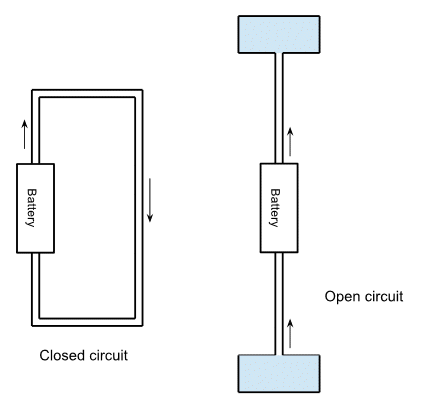
A very common analogy for an electrical circuit is to image it as a series of pipes with water flowing through them. The electrons are analagous to the water, and the battery is the water pump. So the usual closed circuit is shown on the left, with the battery pumping water (electrons!) out of one end of the battery, round the circuit and back in the other end of the battery.


The open circuit is represented by the diagram on the right, where the battery pumps water up from a closed container at the bottom to another closed container at the top. As the battery pumps water the pressure in the bottom decreases and the pressure at the top increases, and at some point the pressure difference will get bigger than the pump can manage. You can use a more powerful pump (i.e. a higher voltage) but even this will reach a point where it can't pump any more water.


This is why a battery in an open circuit can only pump a certain amount of electrons. As it pumps electrons they generate a reverse voltage that opposes the battery.


units - What is the mass of $N_A$ atoms of carbon-12?


With the recent redefinition of the kilogram, what is the mass of $N_A$ (Avogadro's constant) of carbon-12 atoms? $N_A$ was defined as exactly 6.02214076×$10^{23}$ atoms. Then how close would the mass of $N_A$ atoms of carbon-12 be to 12 grams?


Is it still true that the mole is the amount of substance of a system which contains as many elementary entities as there are atoms in 12 gram of carbon-12? Is a mole exactly $N_A$?


Answer


The status of the mass of a mole of $^{12}\rm C$ in the revised SI is basically identical to that of the magnetic vacuum permeability $\mu_0$, which is explored in this and this question. The SI revision does not consist of a re-definition of the kilogram in isolation $-$ instead, the full set of the seven base units get redefined, including in particular the mole, which is no longer defined in terms of a fixed value of the molar mass of carbon-12 and which is instead tied to a fixed value of the Avogadro constant. For the full details, see the over-arching Q&A What are the proposed realizations in the New SI for the kilogram, ampere, kelvin and mole? (as well as this table in the Wikipedia page to see how all the relevant units and constants change status), but the short answer to your question


Then how close would the mass of $N_A$ atoms of Carbon-12 be to 12 grams?


is that it will be close, but not exactly equal, and it will be an experimentally-determined quantity with a finite uncertainty in the future.


This is spelled out explicitly in the Resolution that implements the revision (which will presumably be named as Resolution 1 of the CGPM 2018), and particularly in its appendices, which contain an explicit definition of the mole,


The mole, symbol mol, is the SI unit of amount of substance. One mole contains exactly $6.022 140 76 \times 10^{23}$ elementary entities. This number is the fixed numerical value of the Avogadro constant, $N_A$, when expressed in the unit $\rm mol^{–1}$ and is called the Avogadro number.


The amount of substance, symbol $n$, of a system is a measure of the number of specified elementary entities. An elementary entity may be an atom, a molecule, an ion, an electron, any other particle or specified group of particles.


as well as an explicit comment on the status of the molar mass of carbon-12,


the molar mass of carbon 12, $M(^{12}\mathrm C)$, is equal to $0.012 \:\rm kg \: mol^{–1}$ within a relative standard uncertainty equal to that of the recommended value of $N_Ah$ at the time this Resolution was adopted, namely $4.5 \times 10^{–10}$, and that in the future its value will be determined experimentally.


The appearance of the Planck constant $h$ on the relative uncertainty of $M(^{12}\mathrm C)$ after the change is directly tied to the fact that the relative uncertainty in the mass of the International Prototype Kilogram immediately after the change is exactly equal to the current relative uncertainty in $h$ (because of the way the switch is carried out, and because the second and the meter don't have significant changes).


Can I define the term energy in terms of work?


Recently, I'm doing my personal task which is to formalize every definition and concept in physics, by means of formal language and of course with intuitional notes. Because I found myself that the most of the concepts I'm possesing were quite informal and unclear, for instance, energy. I think I found and read many definitions about energy, but it's still a hard concept to grab.


I know what the work is. My understanding is, roughly speaking, a force $F$ is said to do work on an object $a$ when the displacement $s$ of $a$ is changed in the direction of $F$. And the amount of work $W$ is defined by $\int_C F\cdot\mathrm{d}s$ where $C$ is the path of $a$ in which $F$ is exerting. It's unit called Joule, denoted by $\mathrm{J}$. (Actually, I defined this sorely in formal language, but it is really long to write all of them and hard to read.)


And my understanding of the term energy is that the energy of an object is the highest amount of work which the object can provide to other objects.


My question is, is there any problem to understand the concept of energy like the above? Is the definition inconsistent?


Answer


This kind of definition is actually very conventional at the introductory level. You can find versions of it in many first-year textbooks. Indeed I used my version of this recipe in a recent answer.


You can probably get through an entire undergraduate education in physics on the basis of that kind of definition, but it you delve deeply enough you will eventually find it supplanted by the notion that energy is the Noetherian current associated with invariance in time.


quantum mechanics - Quantization vs. continuous energy levels


I still don't get what it means for atomic energy levels to be continuous or quantitized (incontinuous). Clearing this up will really help me. Also, can anyone tell me why energy levels in solids are continuous while in gases they are quantitized? I get the part about the energy bands being more clustered due to the close proximity that the atoms in solids are, while in gases they are farther apart, but I don't get how this affects the absorption/released ray spectrums and how even THIS affects whether it is continuous or quantitized.


Understanding Stagnation point in pitot fluid

What is stagnation point in fluid mechanics. At the open end of the pitot tube the velocity of the fluid becomes zero.But that should result...